
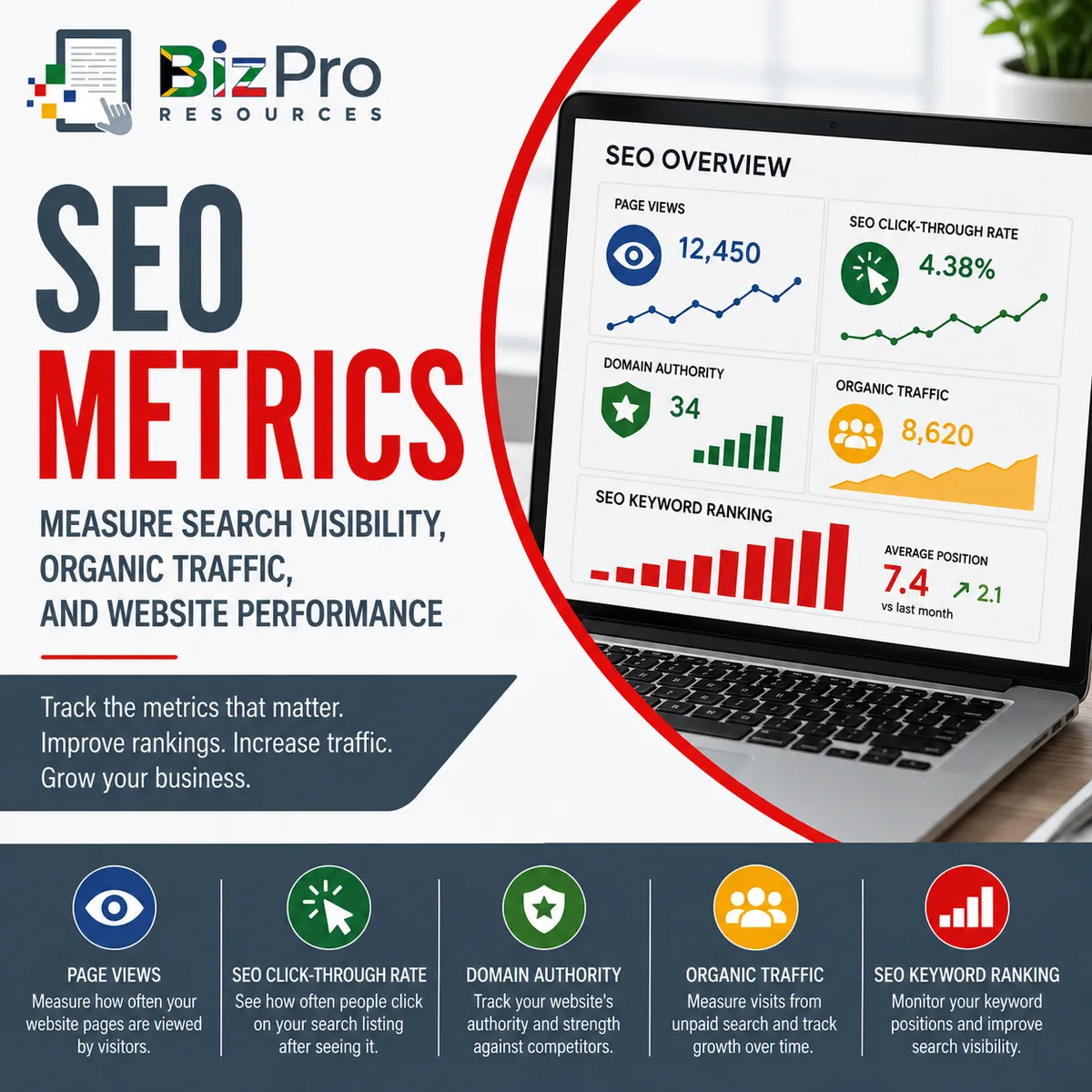
SEO Metrics: Page Views, CTR, Domain Authority, Organic Traffic, and Keyword Rankings Explained
Article #5 of #7 in the Marketing Performance Metrics Series
Introduction
When potential customers need a product, service, or answer to a problem, many of them begin with a search engine.
They may search for:
“accountant near me”
“plumber Johannesburg”
“security company Pretoria”
“how much does solar installation cost?”
“small business tax South Africa”
For businesses, appearing prominently in these search results can create a valuable source of website traffic, enquiries, and customers.
This is the purpose of Search Engine Optimisation, commonly called SEO.
SEO involves improving a website and its content so that search engines can understand it and so that relevant pages have a better chance of appearing prominently when people search for related topics.
Unlike paid search advertising, where businesses pay for advertising placements, organic search traffic generally comes from unpaid search results.
However, SEO is not actually “free”.
A business may still invest in:
Website development
SEO specialists
Content creation
Technical improvements
Keyword research
Website hosting
SEO software
Link-building and digital PR
Staff time
Management therefore needs to know whether these activities are improving search performance.
Five useful SEO metrics are:
Page Views
SEO Click-Through Rate
Domain Authority
Organic Traffic
SEO Keyword Ranking
Together, these metrics help answer five practical questions:
Page Views: How often are people viewing our website pages?
SEO Click-Through Rate: When our pages appear in search results, how often do people click on them?
Domain Authority: How strong does our website appear relative to other websites according to a third-party SEO authority metric?
Organic Traffic: How much website traffic are we receiving from unpaid search results?
SEO Keyword Ranking: Where do our pages appear in search results for important keywords?
No single metric provides a complete picture:
A business might rank highly for keywords nobody searches for.
It might receive large amounts of organic traffic from people who will never become customers.
It might have thousands of page views but very few enquiries.
The objective is therefore not simply to make SEO numbers increase.
The objective is to improve relevant search visibility that supports the goals of the business.
1. Page Views
What Are Page Views?
Page Views measure how many times pages on a website are viewed during a particular period.
If someone opens a page, that generates a page view according to the analytics platform's measurement rules.
If the same person visits several pages, each page may generate another page view.
If the person returns to a page, that may generate another page view as well.
For example, a visitor might view:
Home page
Services page
Pricing page
Contact page
That visitor could generate four page views during one visit.
Page Views therefore measure content consumption, not the number of unique people visiting the website.
How Are Page Views Calculated?
The basic metric is a count: Page Views = Total Number of Recorded Page Views During the Measurement Period
Suppose an accounting practice records:
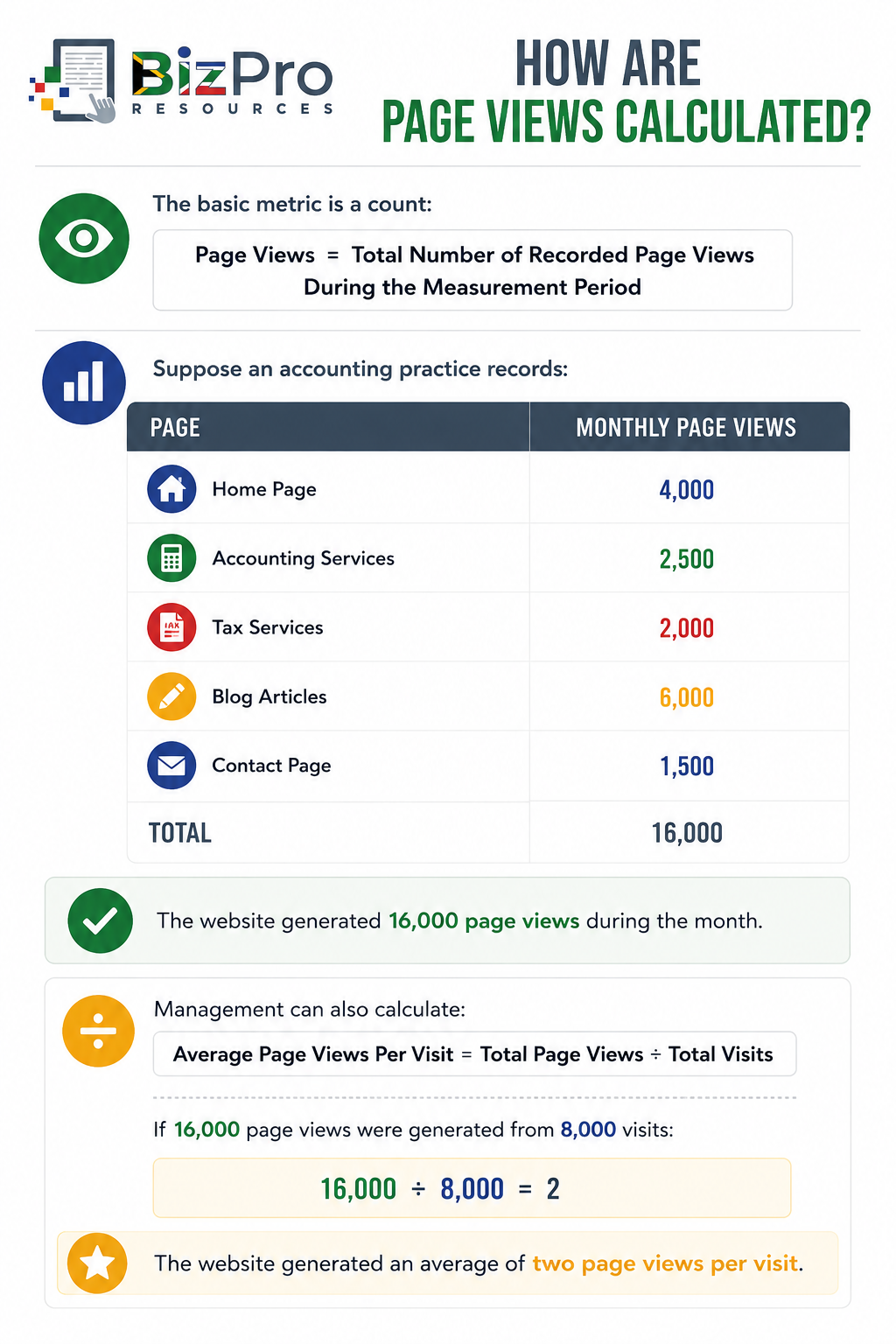
The website generated an average of two page views per visit.
The exact terminology and calculations may differ between analytics platforms, so businesses should understand how their software defines pages, views, users, sessions, and events.
Example of Poor Page View Performance
Imagine a small commercial law firm has invested significantly in its website.
Its monthly results show:
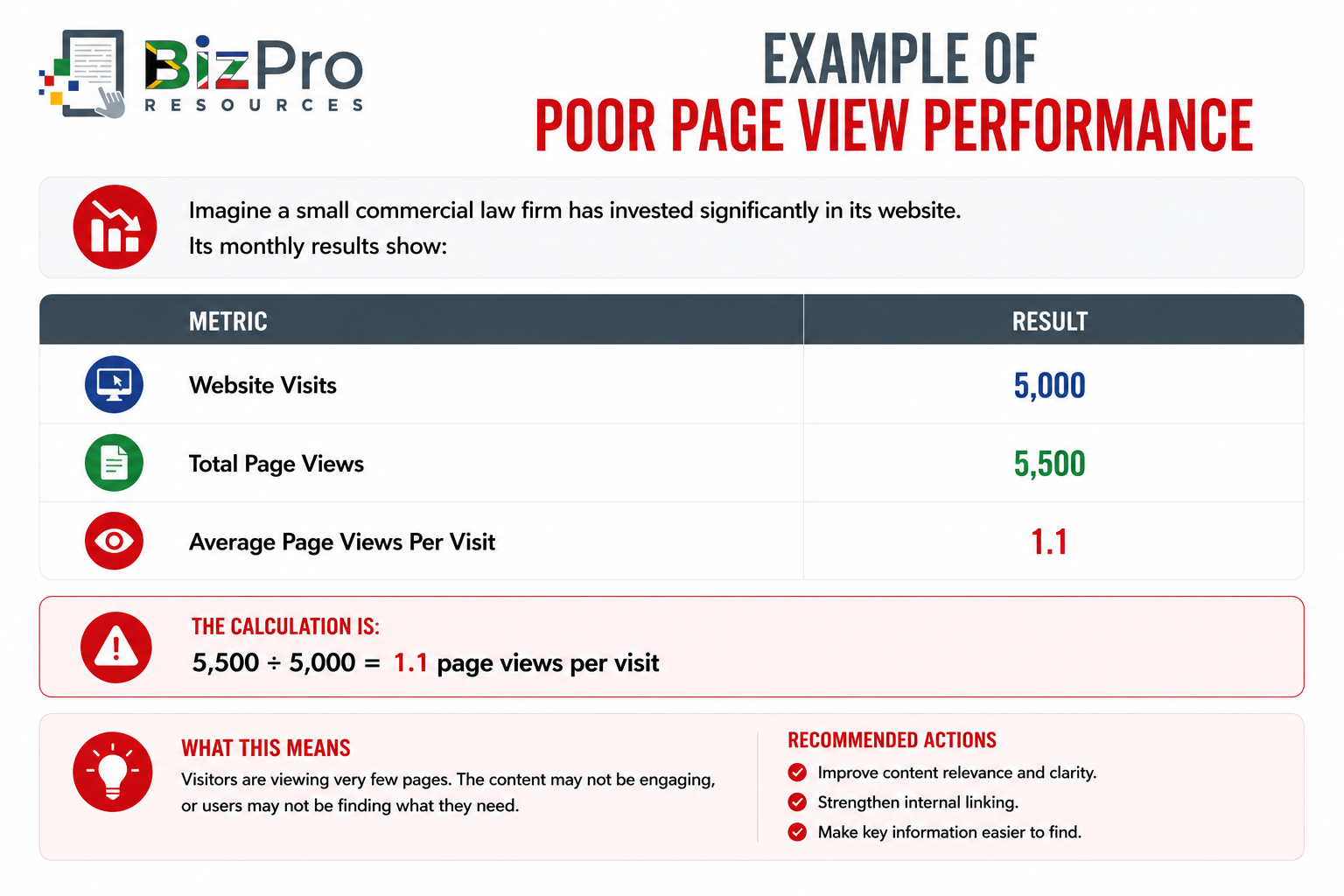
Most visitors appear to view very little additional content.
Assume the firm's historical average was around 2.5 page views per visit and that important service pages have also experienced declining views.
In this context, performance deserves investigation.
What Does Poor Page View Performance Mean for the Company?
Low or declining page views could indicate:
Visitors cannot find useful additional information.
Website navigation is confusing.
Content is weak.
Internal links are poor.
Search traffic is landing on irrelevant pages.
Visitors quickly find what they need and leave.
Website performance is declining.
Important pages are difficult to discover.
Organic search visibility has fallen.
However, low page views are not automatically bad.
Suppose someone searches: “ABC Attorneys phone number”
They arrive directly on the contact page, find the telephone number, and call.
That person may generate only one page view.
Yet the website has successfully helped create a business enquiry.
Page Views therefore need to be interpreted according to the purpose of the website.
Example of Good Page View Performance
The law firm improves its website. It:
Creates detailed service pages.
Adds useful related articles.
Improves internal links.
Simplifies navigation.
Adds links from articles to relevant services.
Creates clear calls-to-action.
The next measurement period shows:
MetricResultWebsite Visits5,000Total Page Views12,500Average Page Views Per Visit2.5
The calculation is: 12,500 ÷ 5,000 = 2.5 page views per visit
What Does Good Page View Performance Mean for the Company?
In this context, increased page views suggest visitors are exploring more of the website.
They may be moving from:
Article → Service Page → About Page → Contact Page
That could indicate stronger engagement and better internal navigation.
But management should still ask: Are the additional page views contributing to enquiries and customers?
More page views are useful only when they support the website's objectives.
2. SEO Click-Through Rate
What Is SEO Click-Through Rate?
SEO Click-Through Rate measures the percentage of times a website's organic search result is clicked after being displayed in search results.
It helps answer: “When people see our page in the search results, how often do they choose our result?”
This metric is useful because ranking alone does not guarantee traffic.
Imagine your website appears 10,000 times in Google search results. If only 50 people click, visibility is not translating effectively into website traffic.
SEO CTR helps measure this relationship.
How Is SEO Click-Through Rate Calculated?
The basic formula is: SEO CTR = Organic Search Clicks ÷ Organic Search Impressions × 100
Suppose a page appears 20,000 times in search results and receives 1,000 clicks.
SEO CTR = 1,000 ÷ 20,000 × 100 = 5%
This means approximately 5% of the recorded search impressions resulted in a click.
Example of Poor SEO Click-Through Rate
Imagine a Johannesburg accounting practice has a page appearing for searches related to small-business accounting.
During a month:
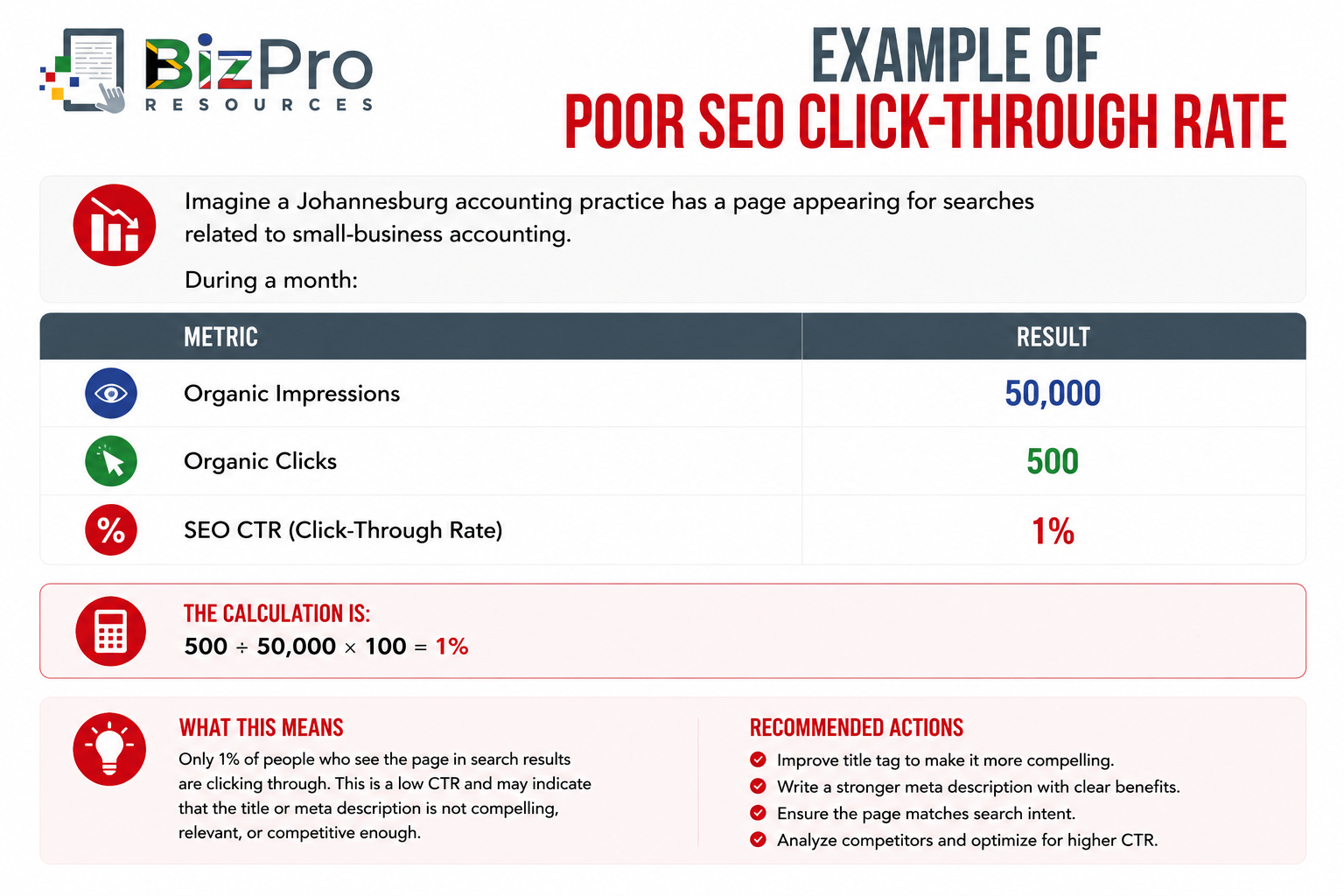
Assume comparable pages in the practice's own historical data perform substantially better at similar ranking positions.
The 1% CTR therefore deserves investigation.
What Does Poor SEO CTR Mean for the Company?
A low SEO CTR can indicate:
Page titles are unattractive.
Search descriptions do not communicate enough value.
The search result does not match user intent.
Competitors have more compelling results.
The page ranks too low on the results page.
The brand is unfamiliar.
Search results contain features that reduce traditional organic clicks.
The keyword attracts people looking for something different.
The company should investigate search queries individually.
A low overall CTR does not necessarily mean every page is performing poorly.
Example of Good SEO Click-Through Rate
The accounting practice improves its search result presentation.
It changes a vague page title from: “Accounting Services”
to something more specific: “Small Business Accounting Services in Johannesburg | ABC Accounting”
It also improves the page content so that it more closely matches the searcher's needs.
The page still generates 50,000 impressions but now receives 3,000 clicks.
SEO CTR = 3,000 ÷ 50,000 × 100 = 6%
What Does Good SEO CTR Mean for the Company?
A higher CTR means a greater percentage of search impressions are turning into website visits.
Previously: 50,000 impressions → 500 clicks
Now: 50,000 impressions → 3,000 clicks
The company has generated six times as many clicks from the same number of impressions.
This can significantly increase the value of existing search visibility.
Ranking Position Affects SEO CTR
SEO CTR should never be evaluated without considering ranking position.
A result appearing near the top of the search results will generally have a much better opportunity to receive clicks than one appearing much lower.
Therefore, comparing CTR for: Position 2 with Position 25 is usually not meaningful without context.
Businesses should compare:
Similar ranking positions.
Similar search intent.
Similar query types.
Historical performance for the same page or query.
This provides a more useful benchmark.
3. Domain Authority
What Is Domain Authority?
Domain Authority is a third-party SEO metric designed to estimate the relative ranking strength of a website or domain.
An important distinction must be made immediately: Domain Authority is not an official Google ranking score.
The term is particularly associated with SEO software providers, and different providers may offer their own authority or domain-strength metrics.
These metrics typically use factors associated with a website's backlink profile and other signals to estimate relative strength.
They are commonly expressed on a numerical scale.
Domain Authority can be useful for:
Comparing websites.
Monitoring changes in perceived domain strength.
Evaluating potential competitors.
Reviewing backlink development.
Supporting broader SEO analysis.
But it should never be treated as the ultimate objective of SEO.
How Is Domain Authority Calculated?
Unlike simple business metrics such as CTR, businesses generally do not calculate Domain Authority manually.
It is calculated by the SEO tool provider using its own methodology and data.
Therefore: Domain Authority = Score Provided by the Relevant SEO Measurement Tool
The exact formula may be proprietary and may change.
For this reason, management should record:
Which SEO tool is being used.
The score at regular intervals.
Competitor scores using the same tool.
Do not compare a score from one provider directly with a different authority metric from another provider as though they are identical.
Example of Poor Domain Authority Performance
Imagine a small South African security company has: Authority Score = 12
Using the same SEO tool, its major competitors score:
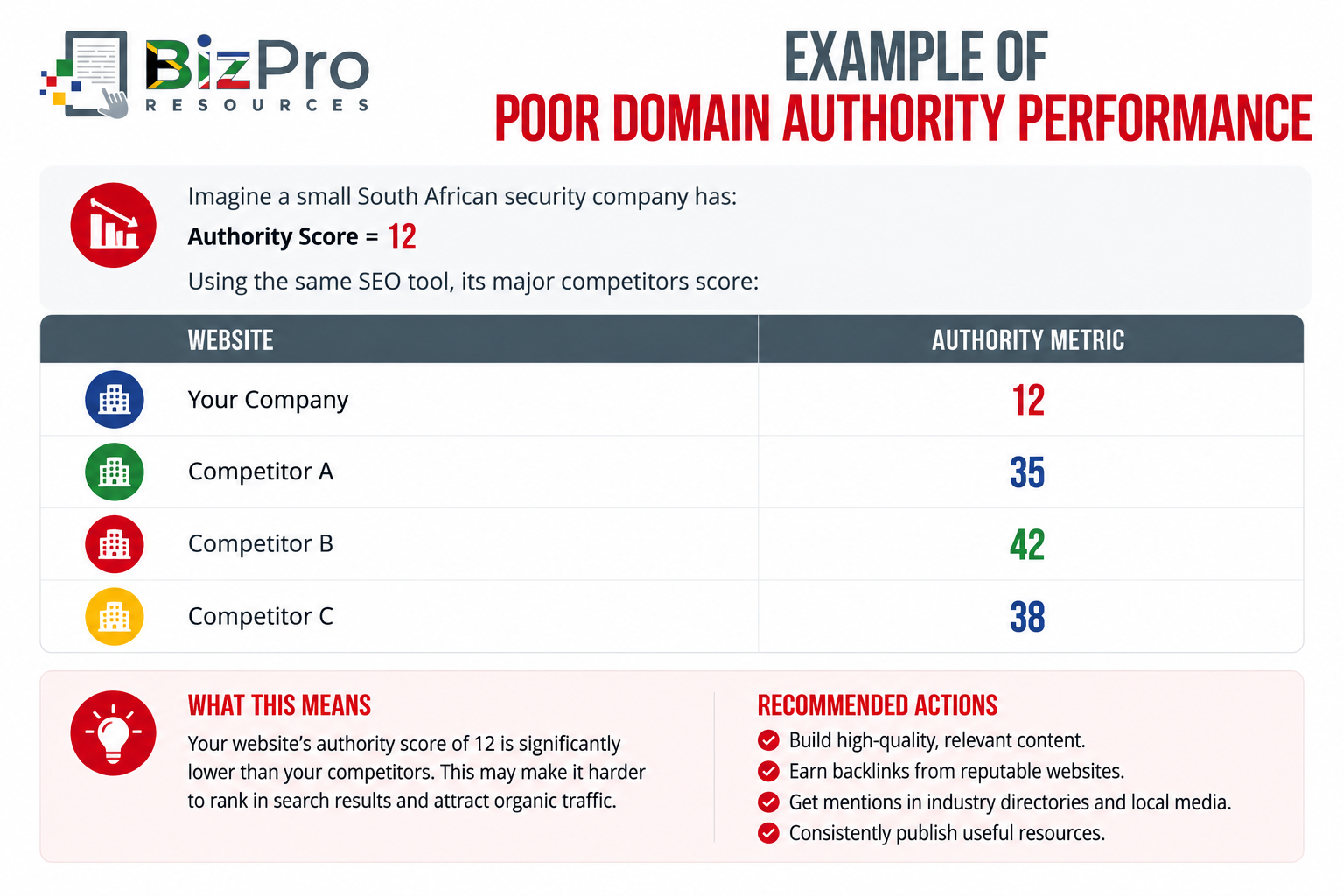
The company's score is substantially below the competitors.
Assume further investigation shows the website has:
Very few quality backlinks.
Limited useful content.
Few external mentions.
A relatively weak online presence.
What Does Poor Domain Authority Mean for the Company?
A relatively weak authority score can indicate that the website's backlink profile or overall perceived domain strength is weaker than competitors according to the selected tool.
This may make competing for difficult search terms more challenging.
Possible causes include:
Few reputable websites linking to the business.
A new website.
Limited content.
Poor-quality backlinks.
Weak digital PR.
Little industry recognition.
Competitors with much stronger established websites.
However, management should not panic simply because the score is low.
A local business can still rank well for commercially valuable local searches without having the highest authority score in its industry.
Domain Authority is a diagnostic and comparative metric, not the business objective.
Example of Good Domain Authority Performance
Over time, the security company:
Publishes useful security guides.
Earns mentions from industry websites.
Builds relationships with relevant organisations.
Creates useful resources other websites reference.
Improves its overall website quality.
Removes or addresses harmful link problems where appropriate.
Its authority metric eventually increases from: 12 → 30
Competitors remain between 35 and 42.
The gap has narrowed significantly.
What Does Good Domain Authority Mean for the Company?
Improvement may indicate that the website's relative authority and backlink profile are strengthening according to the selected SEO tool.
This could support broader SEO performance.
However, management should immediately check whether this improvement is also reflected in:
Keyword rankings.
Organic traffic.
Relevant page views.
Leads.
Customers.
If Domain Authority rises dramatically but organic traffic and commercial outcomes remain unchanged, the business should investigate further.
The goal is not: “Get the highest Domain Authority score possible.”
The goal is: “Improve search visibility and generate commercially useful traffic.”
4. Organic Traffic
What Is Organic Traffic?
Organic Traffic refers to website visits generated through unpaid search engine results.
For example, someone searches: “CCTV installation Cape Town”
They see a company's normal unpaid search result.
They click it.
That visit is classified as organic search traffic by the analytics system.
Organic traffic differs from paid search traffic, where a business pays for advertisements.
It can be particularly valuable because strong SEO can continue producing traffic over long periods.
A useful article published today may continue attracting search visitors months or even years later.
How Is Organic Traffic Calculated?
Organic Traffic is generally recorded automatically by website analytics software.
At its simplest: Organic Traffic = Total Website Visits or Sessions Attributed to Organic Search
Suppose a website receives 20,000 sessions during a month.
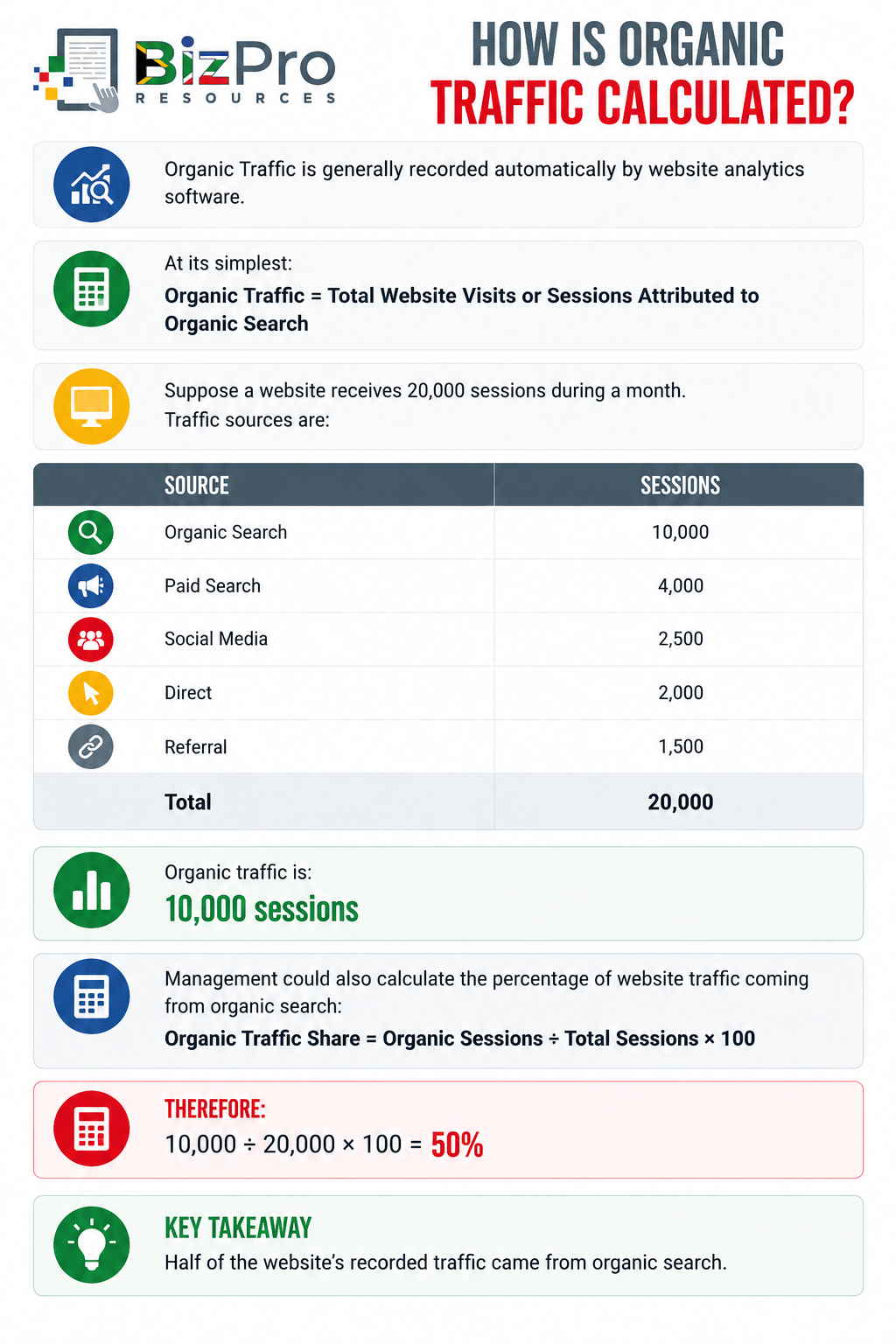
Half of the website's recorded traffic came from organic search.
Example of Poor Organic Traffic Performance
Imagine a Pretoria plumbing company receives: Monthly Organic Traffic = 300 sessions
Its website contains dozens of service pages and articles, but organic traffic has declined steadily:
January: 800
February: 700
March: 550
April: 450
May: 300
The trend is clearly negative.
What Does Poor Organic Traffic Mean for the Company?
Declining organic traffic could indicate:
Keyword rankings have fallen.
Competitors have improved.
Search demand has changed.
Important pages have technical problems.
Website content is outdated.
Pages have been removed or changed.
Search engines are having difficulty accessing or understanding pages.
User search behaviour has changed.
Search result layouts are reducing clicks.
The website has lost important backlinks.
Measurement or tracking has changed.
The business should investigate before assuming the cause.
A decline in organic traffic does not automatically mean the SEO agency or website has failed.
Seasonality can also matter.
For example, searches for certain products may naturally increase or decrease during particular times of year.
Example of Good Organic Traffic Performance
The plumbing company improves its website.
It creates dedicated pages for:
Emergency plumbing.
Burst pipes.
Blocked drains.
Geyser repairs.
Leak detection.
Commercial plumbing.
It also creates useful articles answering common customer questions and improves local search optimisation.
Over time, organic traffic changes:
January: 800
February: 1,000
March: 1,300
April: 1,700
May: 2,200
What Does Good Organic Traffic Mean for the Company?
Growing organic traffic indicates that more website visits are being generated through unpaid search results.
If the traffic is relevant, this can create:
More enquiries.
More quotation requests.
More phone calls.
More brand awareness.
More customers.
But management must check traffic quality.
If organic traffic increases from 1,000 to 10,000 monthly visitors because one article attracts international students researching plumbing theory, that traffic may have little value to a local plumbing business.
The better question is: “Are we increasing relevant organic traffic from people who matter to the business?”
5. SEO Keyword Ranking
What Is SEO Keyword Ranking?
SEO Keyword Ranking refers to the position where a website or webpage appears in organic search results for a particular search query.
For example, a Cape Town electrical contractor may track:
“electrician Cape Town”
“emergency electrician Cape Town”
“solar installer Cape Town”
“commercial electrician Cape Town”
If the company's page appears as the third organic result for a particular query, it might be reported as: Keyword Ranking = Position 3.
Generally, moving toward Position 1 indicates improved visibility. But keyword rankings are not always fixed.
Results may vary according to:
Location.
Device.
Search history.
Search engine.
Search intent.
Personalisation.
Search result features.
Time.
Keyword rankings should therefore be treated as useful indicators rather than perfectly fixed positions.
How Is SEO Keyword Ranking Calculated?
Unlike percentage metrics, keyword ranking is primarily a position.
For example:
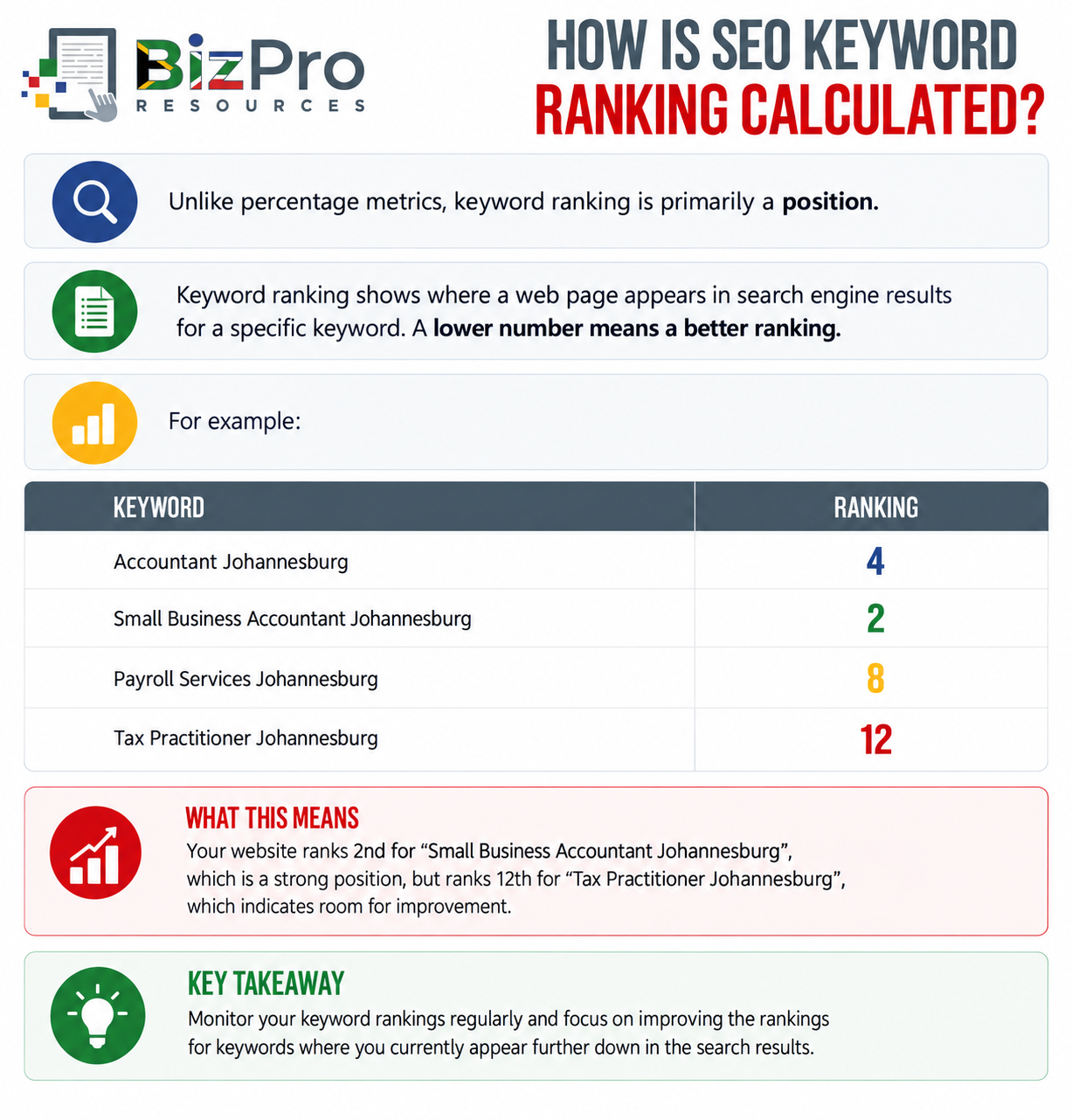
Businesses can also track movement.
For example:
Previous Position = 15
Current Position = 5
The keyword has improved by 10 positions.
SEO software may also calculate averages across many keywords, but management should still inspect important individual keywords.
Example of Poor SEO Keyword Ranking
Imagine a Johannesburg IT support company wants to attract SMEs.
It tracks:
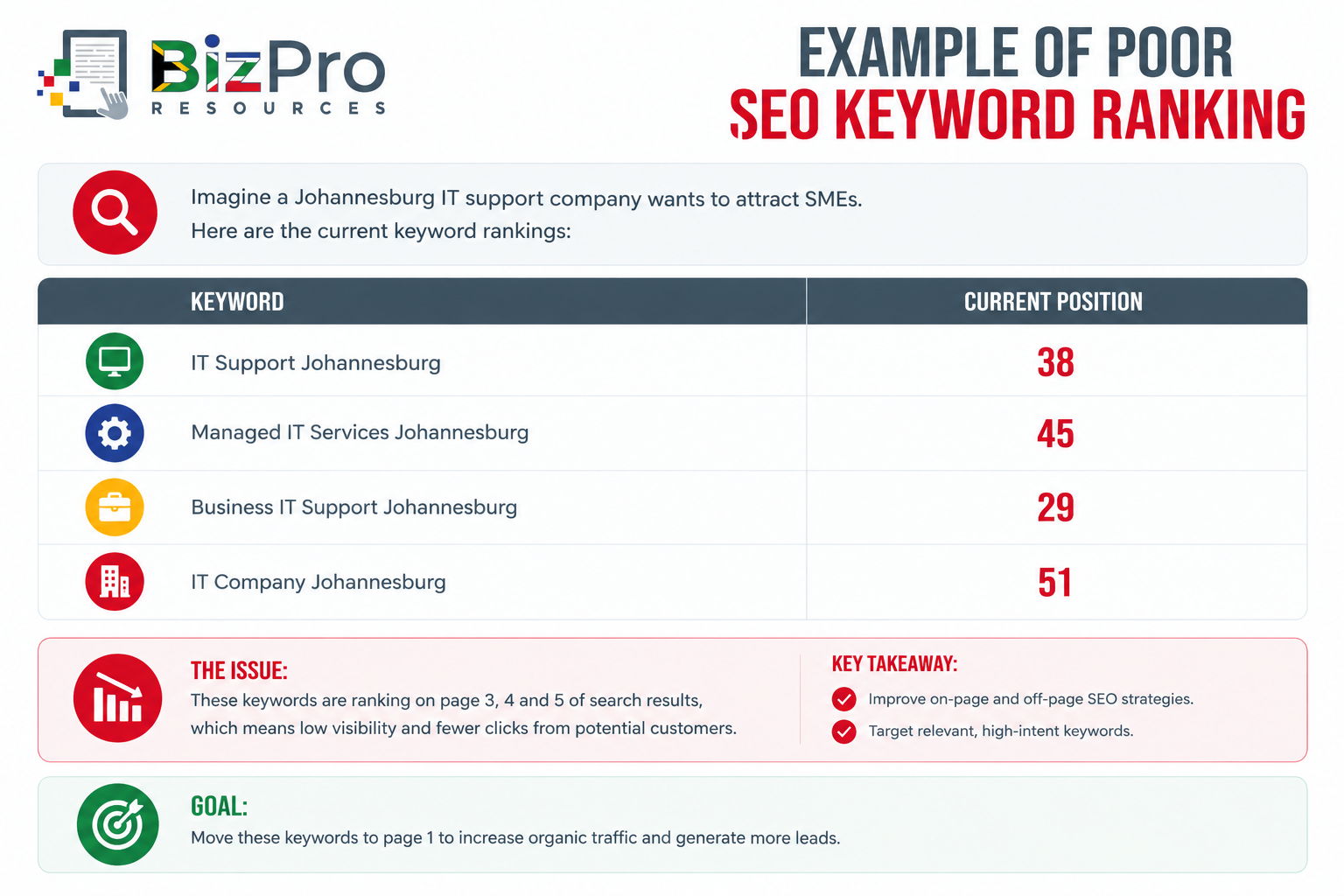
The business has pages targeting these services, but most rank far below the first page of search results.
What Does Poor Keyword Ranking Mean for the Company?
Poor rankings mean potential customers may struggle to discover the business through those searches.
Possible causes include:
Weak content.
Poor keyword targeting.
Strong competition.
Technical SEO problems.
Weak website authority.
Poor internal linking.
Search intent mismatch.
A relatively new website.
Competitors offering better pages.
Weak local relevance.
The company may be invisible for commercially important searches even though it has a professional-looking website.
A beautiful website that nobody discovers through search has limited SEO value.
Example of Good SEO Keyword Ranking
The IT company improves its website and creates stronger pages around the services its target customers actually search for.
After several months:
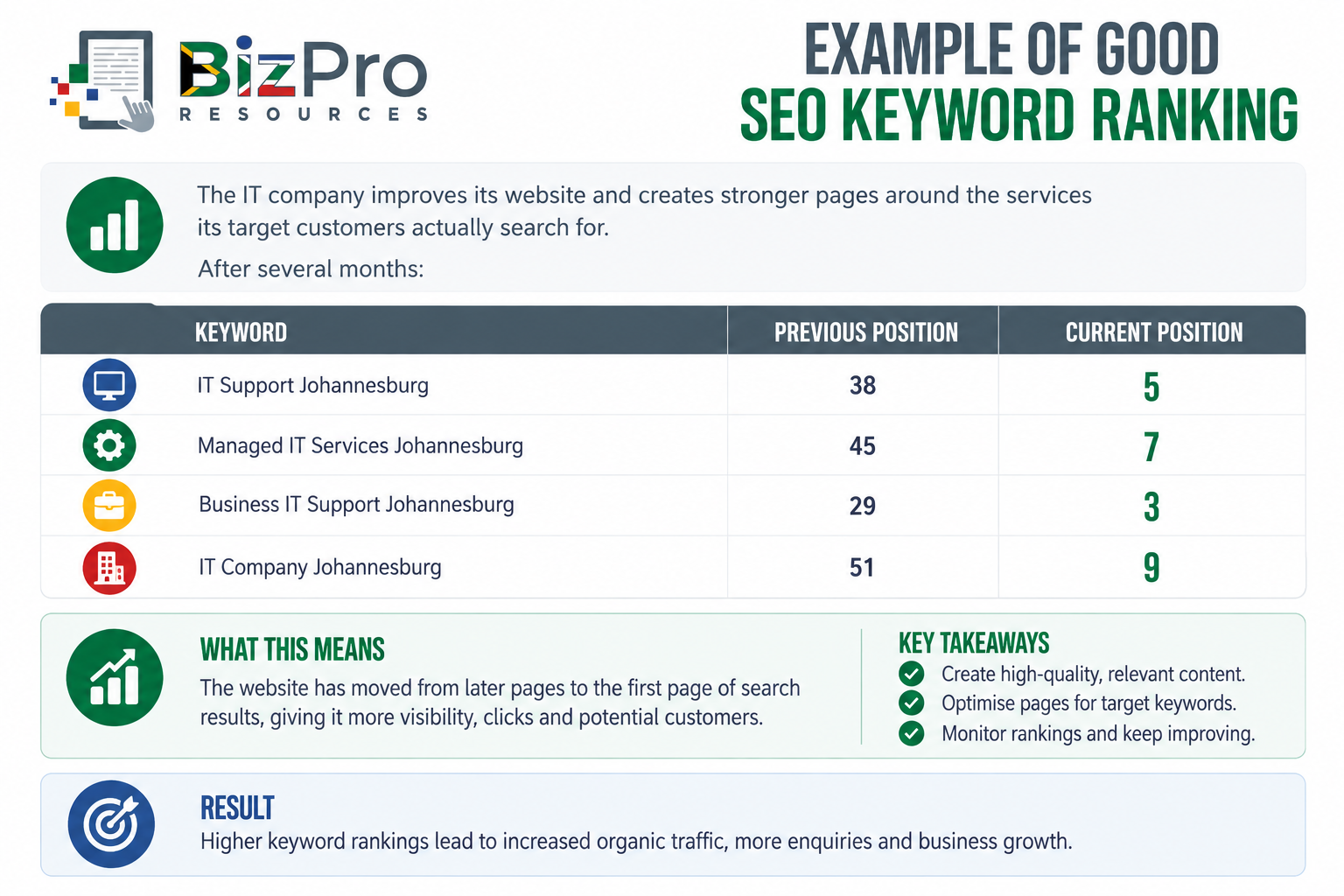
All four important keywords now appear much more prominently.
What Does Good Keyword Ranking Mean for the Company?
Improved rankings can increase the opportunity to:
Appear in front of potential customers.
Generate organic impressions.
Receive organic clicks.
Increase organic traffic.
Generate enquiries.
But ranking is still not the final objective.
Suppose the business reaches Position 1 for: “history of computers in Johannesburg” but its target customers search: “IT support for small business Johannesburg.”
The first ranking may generate traffic without producing meaningful commercial value.
The business should prioritise keywords based on relevance and customer intent, not simply ranking difficulty or search volume.
How the Five SEO Metrics Work Together
These five metrics measure different stages of search performance.
A useful sequence is:
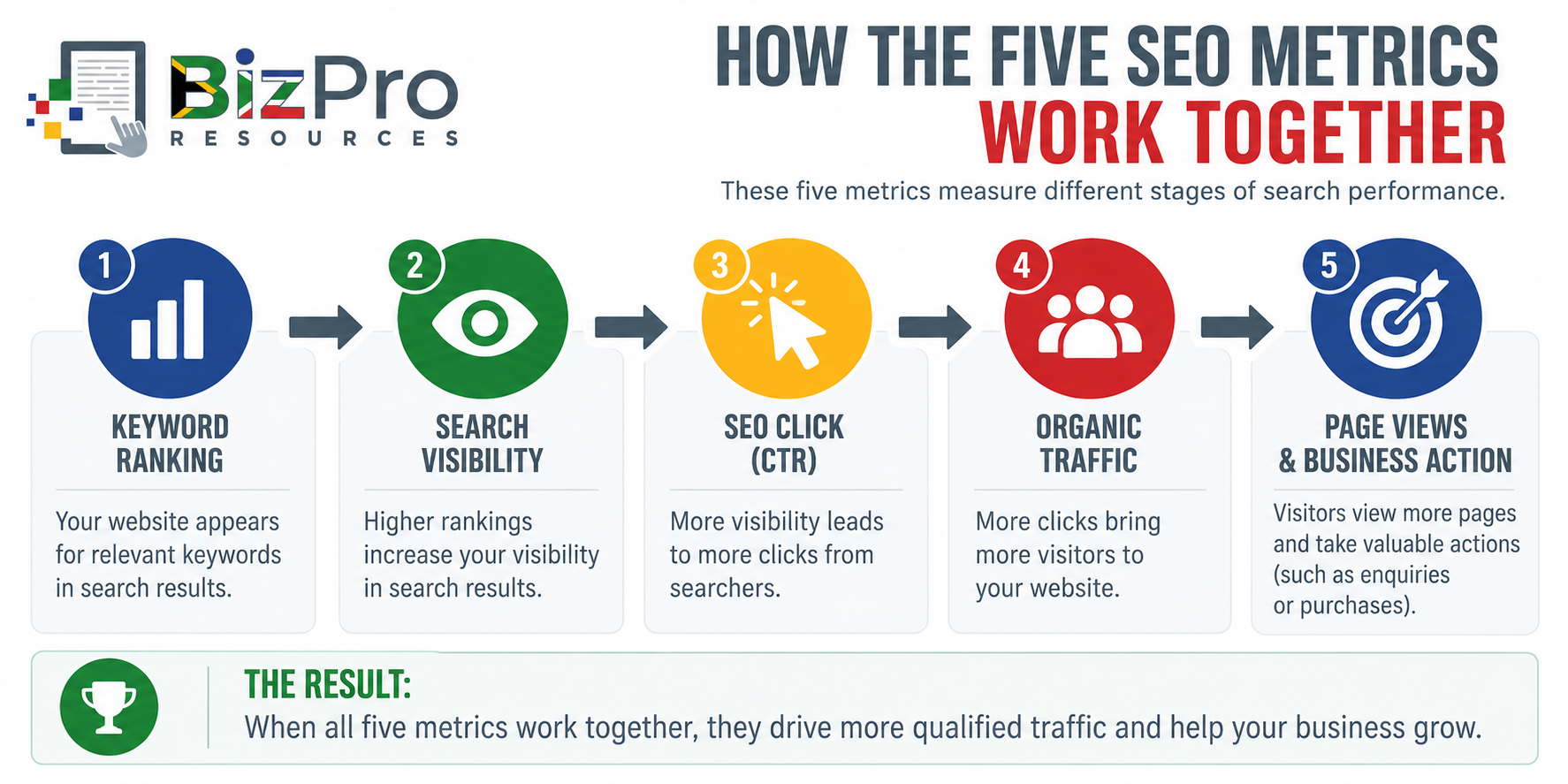
Consider what happens when a page improves from Position 15 to Position 3:
Better ranking can increase visibility.
More visibility creates more opportunities for clicks.
A strong search result can improve CTR.
More clicks generate organic traffic.
Those visitors generate page views.
Some may then:
Call.
Enquire.
Request quotations.
Subscribe.
Buy.
Domain Authority can support the broader ability of a website to compete, but it sits alongside this process rather than replacing it.
Example of How the Metrics Work Together
Imagine a small accounting practice records:
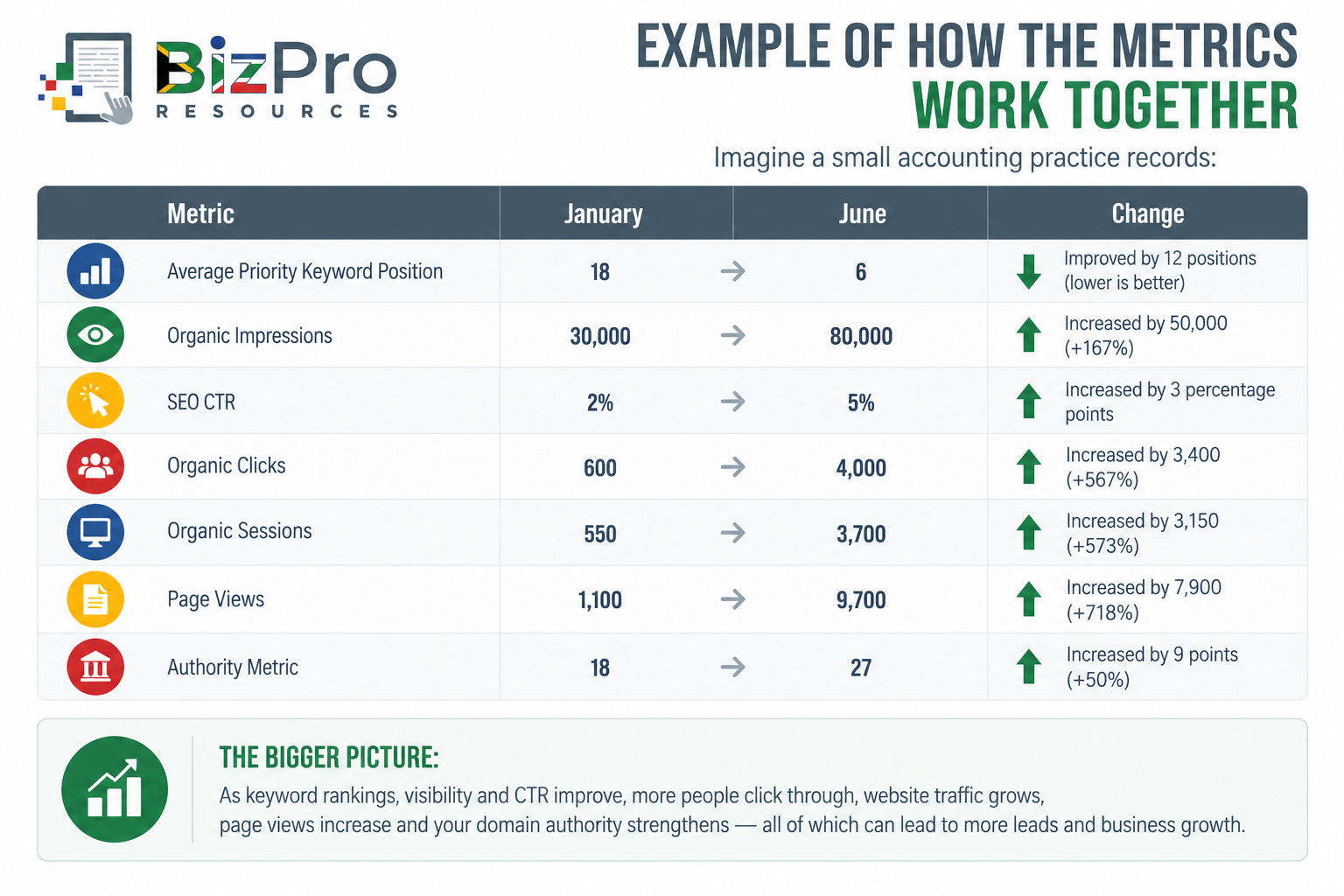
The story is much clearer when the metrics are viewed together:
Keyword rankings improved.
Search visibility increased.
CTR improved.
Organic traffic grew.
Page views increased.
The website's third-party authority score also strengthened.
Management should now ask the most important question: Did this improvement produce more leads and customers?
That connects SEO metrics to the broader marketing measurement system.
Do Not Chase Keyword Rankings for the Wrong Keywords
One of the biggest SEO mistakes is celebrating rankings without considering commercial relevance.
Imagine a security company ranks first for: “history of CCTV cameras” The page generates 5,000 visitors per month.
But most visitors are:
Students.
Researchers.
People outside South Africa.
People with no intention of buying security services.
Meanwhile, the company ranks Position 30 for: “CCTV installation Pretoria.”
Which keyword deserves more management attention? Probably the second one.
It may have lower search volume, but the person searching it is much closer to becoming a customer.
SEO should focus on business value, not merely traffic volume.
Segment Organic Traffic
Do not look only at total organic traffic.
Break it down.
For example:
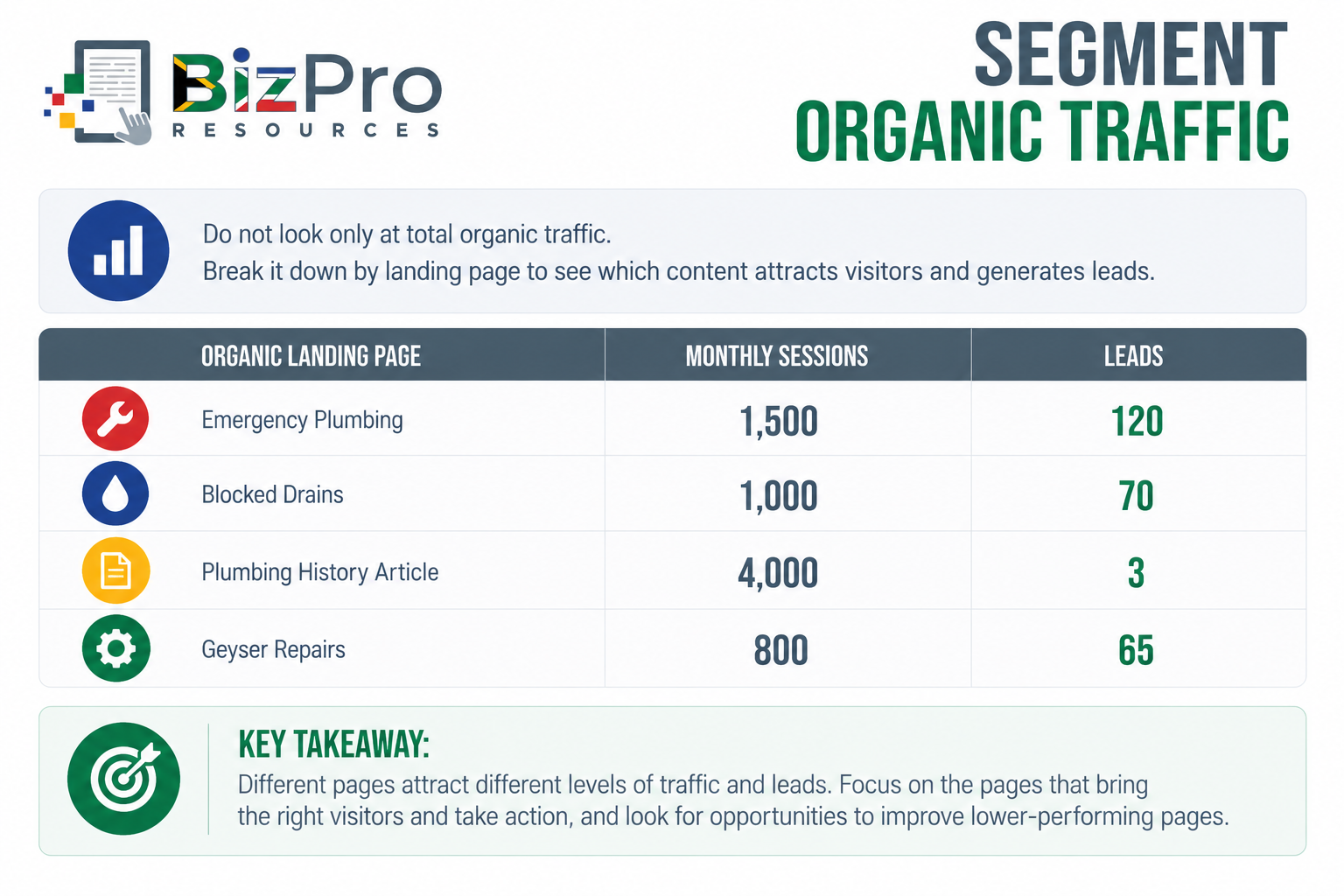
The history article generates the most traffic.
But the emergency plumbing page generates far more leads.
This is extremely important.
If management looks only at page views and organic traffic, it may conclude that the history article is the most valuable page.
Commercially, the service pages may be much more important.
Build a Simple SEO Dashboard
A small business can track its SEO performance in a monthly dashboard.
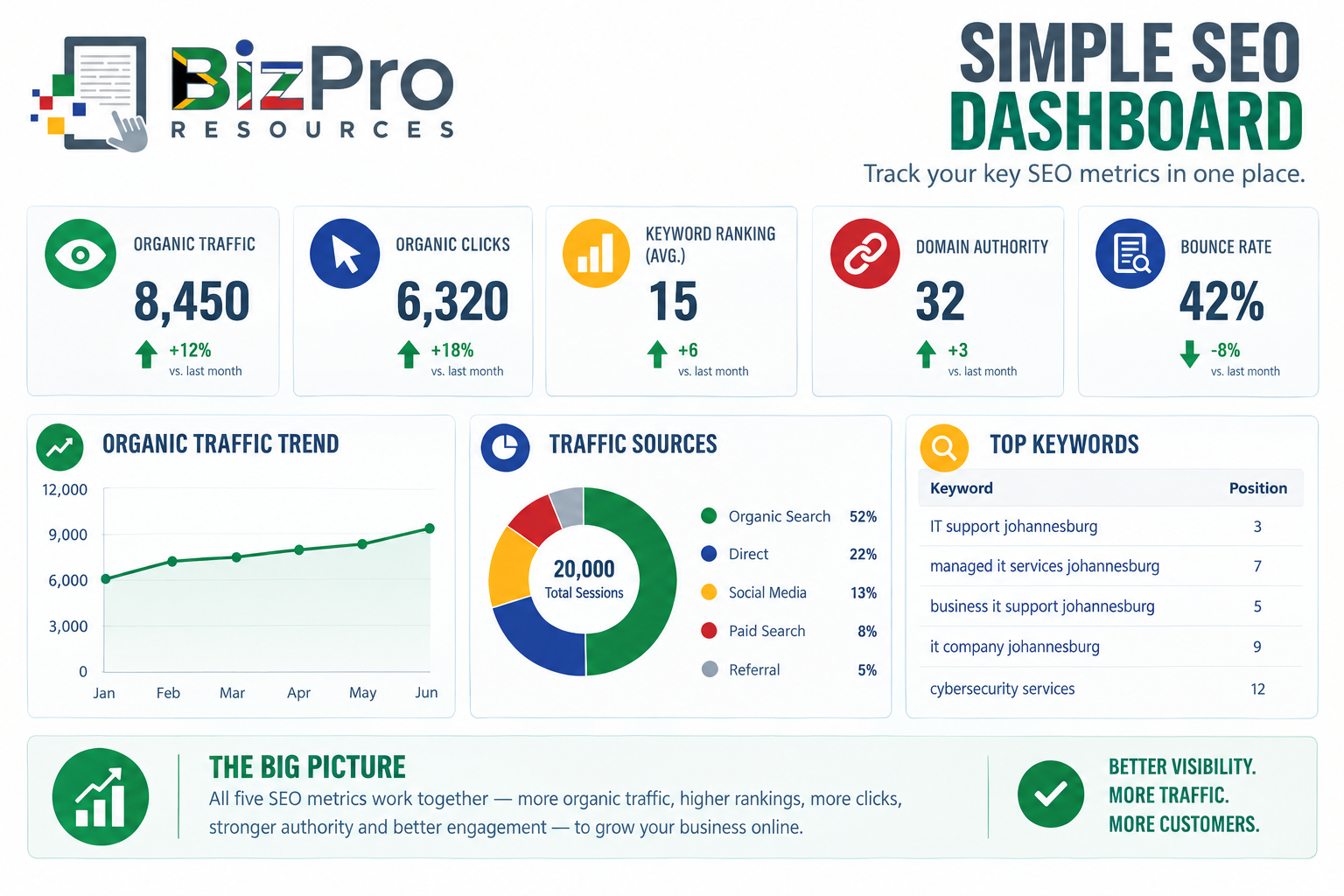
Notice the final row:
Organic Leads
This connects SEO performance with commercial activity.
Eventually, management should also connect SEO to:
Qualified leads.
Customers.
Revenue.
CAC.
CLV.
ROI.
Watch SEO Trends Over Time
SEO is often a longer-term marketing activity.
Results may not change immediately.
Management should therefore monitor trends.
For example:
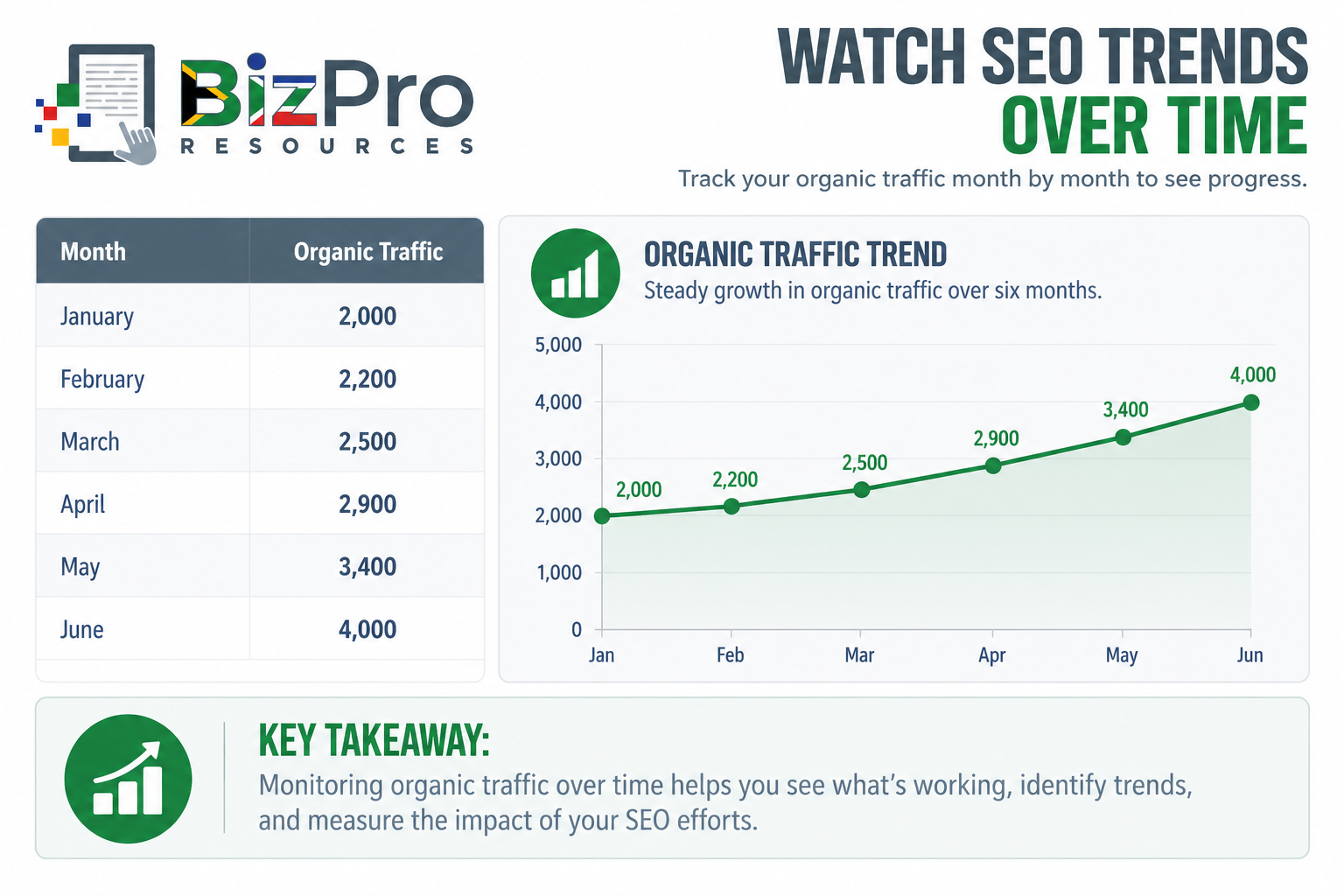
The month-to-month changes may not seem dramatic.
But over six months, organic traffic has doubled.
The opposite can also happen.
A gradual decline may indicate a problem long before management notices a dramatic drop.
SEO Metrics Can Move in Different Directions
Not every metric will always improve together.
Suppose:
Keyword Rankings ↑
Organic Impressions ↑
SEO CTR ↓
Why?
The website may now appear for many more searches, including queries where it ranks lower.
Or search result features may have changed.
Or new queries may have different user behaviour.
Another situation could be:
Organic Traffic ↓
Organic Leads ↑
That sounds contradictory.
But perhaps the business removed low-value content and now attracts fewer but much more relevant visitors.
This could actually represent an improvement. The goal is not to force every number upward.
The goal is to understand what the numbers mean for the business.
Be Careful When Comparing SEO Performance
SEO results vary according to:
Industry.
Competition.
Location.
Website age.
Search demand.
Seasonality.
Search engine changes.
Content quality.
Website authority.
Search intent.
A local plumbing company should not compare its Domain Authority or organic traffic directly with a national news website.
A new accounting practice should not expect the same search visibility as a major financial institution.
The most useful comparison is often: Your performance today versus your performance previously.
And: Your performance versus realistic competitors targeting the same customers.
What Does Good SEO Performance Look Like?
Good SEO performance does not simply mean: More traffic.
It means the business is becoming more visible for relevant searches and converting that visibility into useful website activity.
Healthy SEO performance generally means:
Page Views are increasing on relevant pages - Visitors are consuming useful content and exploring important website pages.
SEO CTR is healthy or improving where appropriate - Search visibility is translating into clicks.
Domain Authority or comparable third-party authority measures are strengthening relative to relevant competitors - The website is becoming more competitive according to the chosen SEO tool.
Organic Traffic is growing in quality as well as quantity - More relevant people are arriving through unpaid search.
Important Keyword Rankings are improving - The business is becoming more visible for searches that matter commercially.
And most importantly: SEO contributes to leads, customers, and business value.
Turning SEO Metrics into Action
SEO metrics should result in decisions.
If Page Views are poor, investigate:
Content quality.
Internal linking.
Navigation.
Organic traffic.
Page relevance.
If SEO CTR is poor, investigate:
Search position.
Page titles.
Search descriptions.
Search intent.
Competitor results.
Query relevance.
If Domain Authority is weak, investigate:
Backlink quality.
Digital PR.
Useful content.
Industry relationships.
Competitor backlink profiles.
If Organic Traffic is falling, investigate:
Rankings.
Technical problems.
Content changes.
Search demand.
Competitors.
Tracking changes.
If Keyword Rankings are poor, investigate:
Content quality.
Search intent.
Keyword targeting.
Technical SEO.
Internal links.
Website authority.
Competitor pages.
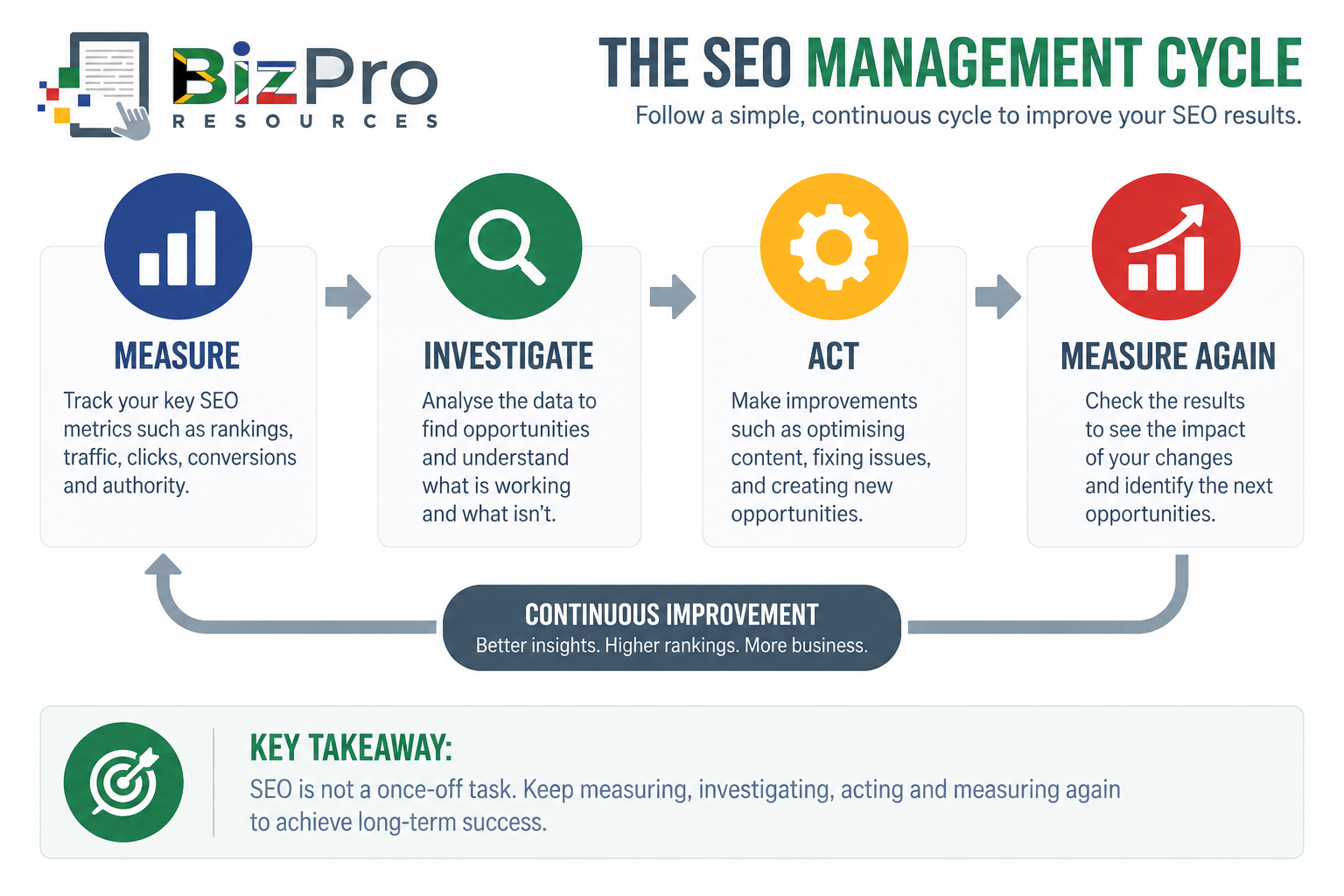
Then improve what needs improvement.
Measure again.
Compare the results.
Continue learning.
SEO management should follow the same continuous cycle:
Final Thoughts
SEO can become confusing because businesses have access to so many numbers:
Rankings.
Traffic.
Clicks.
Impressions.
Authority scores.
Page views.
The danger is turning SEO into a scoreboard rather than a business tool:
Ranking first is useful only if the keyword matters.
More organic traffic is useful only if the visitors are relevant.
More page views are useful only if people are consuming useful content or moving toward a meaningful action.
A higher authority score is useful only when it supports stronger overall search performance.
Remember what each metric is telling you:
Page Views tell you how much website content is being viewed.
SEO Click-Through Rate tells you how effectively search visibility turns into clicks.
Domain Authority provides a third-party indication of relative website strength.
Organic Traffic tells you how many visits are being generated through unpaid search.
SEO Keyword Ranking tells you how prominently your website appears for important searches.
Together, these metrics help management understand whether the business is becoming easier for potential customers to find online.
But the ultimate objective is not: More SEO.
The objective is: Better visibility for the right searches, more relevant visitors, more valuable customer actions, and stronger business results.
That is when SEO moves from being a technical marketing activity to becoming a measurable contributor to business growth.
Related Articles in the Marketing Performance Metrics Series
Marketing Financial Metrics: ROI, CAC, CLV, and ROAS Explained
Marketing Conversion and Lead Metrics: CVR, CPL, and MQL Explained
Marketing Traffic and Engagement Metrics: CTR, Bounce Rate, and Engagement Rate Explained
Social Media Metrics: Followers, Comments, Engagement Rate, and Video Views Explained
SEO Metrics: Page Views, CTR, Domain AUthority, Organic Traffic, and Keyword Rankings Explained
Email Marketing Metrics: CTOR, Engagement, Website Traffic, Bounce Rate, and CTR Explained
AI Disclaimer
AI Tools were used to assist with research. Remember to always cross-check everything that you read.


