
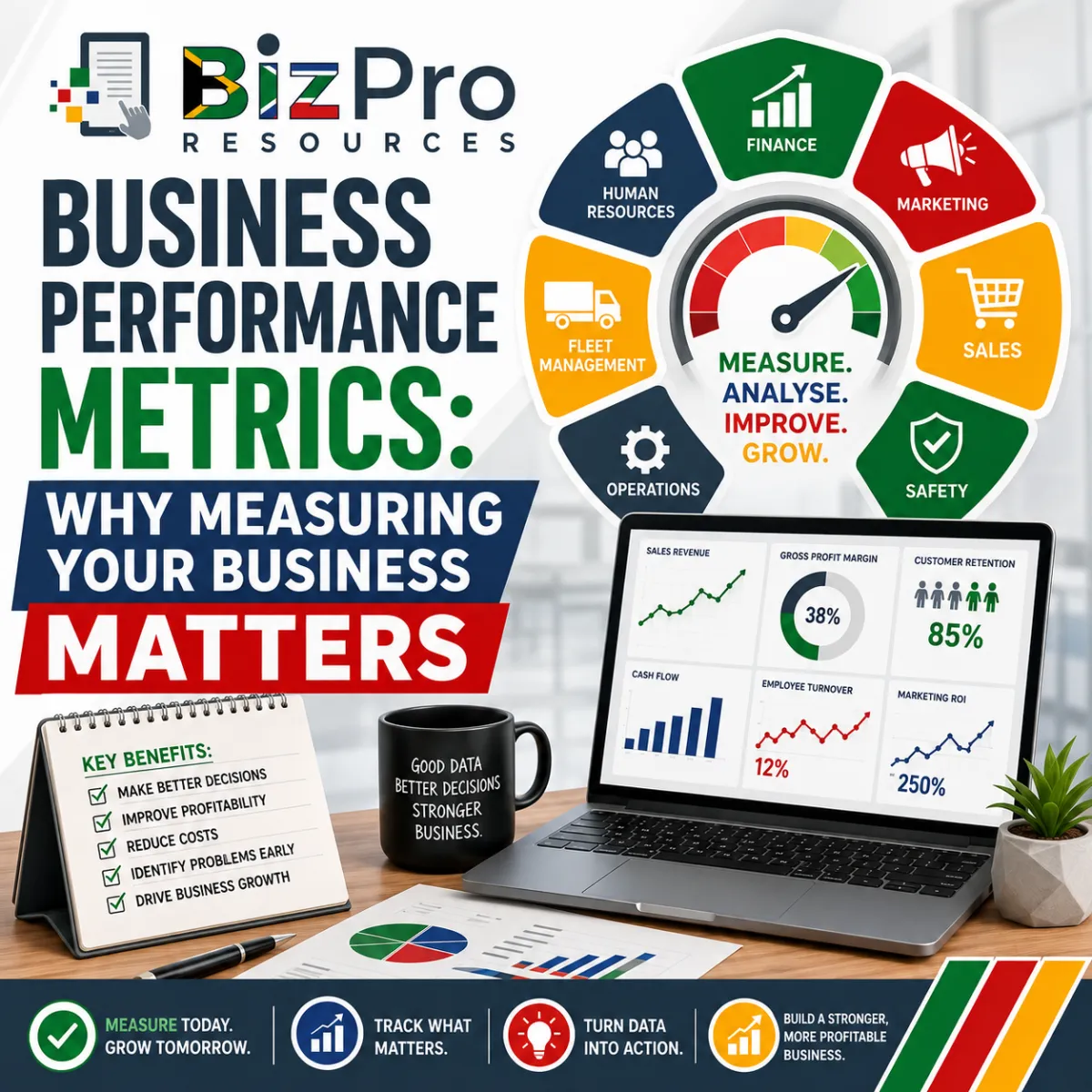
Business Performance Metrics: Why Measuring Your Business Matters
Article #1 of #1 in the Business Performance Metrics Series
Introduction
Running a small business can sometimes feel like driving a car without a dashboard.
You know that the business is moving. Customers are calling. Employees are working. Money is coming into the bank account. Suppliers need to be paid. Marketing campaigns are running. Problems appear and need to be solved.
But how do you know whether the business is actually performing well:
Is your profit improving?
Are your sales growing?
Are your marketing campaigns bringing in enough customers?
Are you keeping your existing customers?
Are your employees productive?
Is your business becoming more efficient?
Are workplace safety problems increasing or decreasing?
Are your vehicles costing more to operate than they should?
Many small business owners answer these questions based on what they feel is happening.
That can be dangerous.
A business owner might say: “We are very busy, so business must be good.” But being busy does not necessarily mean being profitable.
Another owner might say: “Our sales increased this year.” That sounds positive. But what if expenses increased even faster than sales?
Another might say: “Our Facebook page has thousands of followers.” That sounds impressive. But are those followers becoming paying customers?
This is why successful businesses measure their performance.
There is a simple management principle that every small business owner should understand: You cannot properly manage something if you are not measuring it.
This does not mean that you need complicated software, a large finance department, or a business degree.
It means identifying the important numbers in your business, tracking them regularly, understanding what they are telling you, and using that information to make better decisions.
These numbers are often called business performance metrics.
In this new BizPro Resources article series, we are going to explore the performance metrics that small business owners should understand and show you how they can be used in a practical South African small business.
What Is a Business Performance Metric?
A business performance metric is simply a number or measurement that helps you understand how a particular part of your business is performing.
For example, imagine that you own a plumbing business:
During one month, your business receives 100 customer enquiries.
Your team provides 70 quotations.
Of those quotations, 35 customers accept.
Those numbers already tell you something about your business.
You could measure:
how many enquiries you receive;
how many enquiries become quotations;
how many quotations become jobs;
the average value of each job;
how much revenue those jobs generate;
how much it costs to complete those jobs; and
how much profit remains after your expenses.
Each measurement gives you another piece of information. Together, they start creating a picture of how your business is performing. This is what business metrics are designed to do.
They turn everyday business activity into information that you can use.
Stop Managing Your Business Only by Feeling
Small business owners often develop excellent instincts. After operating a business for several years, you may be able to sense when something is wrong:
Perhaps the phones are quieter than usual.
Perhaps customers seem to be complaining more often.
Perhaps your bank balance is becoming uncomfortable.
Perhaps employees seem less productive.
Perhaps vehicles are spending too much time being repaired.
Those instincts are valuable. But instinct should not replace information.
Consider a small security company. The owner believes that the company is growing because revenue increased from R4 million to R5 million. Revenue increased by 25%. Excellent news?
Maybe. But then the owner looks deeper.
Over the same period:
fuel costs increased;
overtime increased;
vehicle maintenance costs increased;
employee turnover increased;
the company hired additional supervisors;
customer cancellations increased; and
profit actually decreased.
The business became bigger, but it did not necessarily become better.
Without measuring the right numbers, the owner might not realise this until the business develops serious cash-flow problems.
Metrics allow you to move from: “I think this is happening.” to: “The numbers show us what is happening.”
That is a major improvement in the way a business is managed.
Your Business Already Produces Data
The word data can sound technical.
Many small business owners hear words such as data analytics, performance dashboards, business intelligence and KPIs and immediately think that these ideas belong to large corporations.
They do not.
Your small business is already producing information every day.
Think about the information that may already exist in your business:
sales invoices;
quotations;
bank transactions;
accounting records;
customer lists;
supplier invoices;
employee attendance records;
payroll information;
website statistics;
social media statistics;
email marketing reports;
WhatsApp Business activity;
vehicle fuel records;
maintenance records;
customer complaints;
accident records;
training records; and
stock records.
The problem is often not that the information does not exist. The problem is that nobody is turning the information into useful measurements. For example, you might know that 12 employees left your company last year.
That is information.
But what percentage of your workforce does that represent?
Is the percentage increasing?
Which departments are losing the most employees?
How many employees leave within their first 12 months?
How much is employee turnover costing the business?
Now you are starting to turn information into management insight.
Metrics Help You Ask Better Questions
One of the greatest benefits of business performance metrics is that they encourage better questions. Suppose sales revenue falls by 15%. That number does not automatically tell you why sales declined.
Instead, it tells you where to investigate.
You might ask:
Did we lose customers?
Did customers buy less frequently?
Did our average sale value decrease?
Did we receive fewer leads?
Did our sales conversion rate decrease?
Did a major customer leave?
Did competitors enter our market?
Did we increase our prices?
Is there a seasonal reason for the decline?
The metric is not always the answer. Sometimes the metric tells you which question you should ask next. That is an important idea to understand.
Good business measurement is not about collecting hundreds of numbers.
It is about using the right numbers to understand what is happening inside your business.
The Difference Between a Metric and a KPI
During this series, you will sometimes see the term KPI. KPI stands for Key Performance Indicator.
Although people sometimes use the words metric and KPI as if they mean exactly the same thing, there is a useful difference.
A metric is something you measure.
A KPI is a particularly important measurement that helps you judge whether the business is achieving an important goal.
For example, your business might measure:
website visitors;
quotations issued;
sales revenue;
gross profit margin;
customer retention;
employee turnover; and
cash flow.
All of these can be useful metrics.
But if your main goal this year is improving profitability, your gross profit margin might become one of your most important KPIs.
If your biggest problem is losing customers, your customer retention rate might become a KPI.
If you are struggling with staff shortages, your employee turnover rate might become a KPI.
In simple terms: Every KPI is a metric, but not every metric needs to be a KPI.
You do not need to treat every number as equally important.
Why Small Businesses Should Measure Performance
Large companies usually have accountants, analysts, HR departments, marketing teams and sophisticated reporting systems. Small businesses often do not. That actually makes good measurement even more important.
When resources are limited, poor decisions can be expensive:
Imagine spending R20,000 every month on advertising without knowing whether the advertising is producing customers.
Imagine carrying R500,000 worth of stock without knowing how quickly that stock is selling.
Imagine losing experienced employees every few months without measuring employee turnover.
Imagine operating ten vehicles without knowing what each vehicle actually costs per kilometre.
Imagine giving discounts to customers without understanding your gross profit margin.
Each of these situations can quietly damage a business.
Performance metrics can help a small business owner:
identify problems earlier;
control costs;
improve profitability;
understand customers;
improve sales;
evaluate marketing;
manage employees;
improve productivity;
reduce waste;
manage cash flow;
improve safety;
compare performance over time; and
make better business decisions.
Most importantly, metrics help replace assumptions with evidence.
A Metric Becomes Valuable When You Compare It
A number by itself often tells you very little.
Suppose your business made R180,000 in sales this month. Is that good? We cannot answer yet. We need something to compare it with.
Perhaps:
Last month: R150,000
This month: R180,000
Now we know sales increased by R30,000.
Or perhaps:
Sales target: R220,000
Actual sales: R180,000
Now we know the business missed its target by R40,000.
Or:
August last year: R160,000
August this year: R180,000
Now we can see year-on-year growth.
This is where measurement becomes much more useful.
You can compare:
Actual vs target: What did we want to achieve, and what did we actually achieve?
This month vs last month: Are we improving or declining?
This year vs last year: Is the business growing over a longer period?
Branch vs branch: Which location performs better?
Salesperson vs salesperson: Where might additional coaching be required?
Marketing campaign vs marketing campaign: Which campaign produces better results?
The purpose is not simply to produce reports.
The purpose is to identify differences and understand why those differences exist.
Do Not Measure Everything
Once business owners discover performance metrics, another problem can appear. They start measuring too much. A modern business can potentially track hundreds or even thousands of different numbers.
That does not mean you should. Imagine receiving a report every Monday containing 150 different measurements. You probably would not know where to look first.
Instead, ask: Which numbers would help me make better decisions?
That question should guide your measurement system. A small business might begin with only five or ten important metrics. As the business becomes more sophisticated, additional measurements can be added.
The goal is not to create the biggest spreadsheet. The goal is to create useful management information.
Different Parts of Your Business Need Different Metrics
Your business is made up of different activities:
Finance needs different measurements from marketing.
Marketing needs different measurements from human resources.
Human resources needs different measurements from fleet management.
That is why this Business Performance Metrics series will explore several important areas.
The topic outline for this BizPro series covers a wide range of measurements, including finance, sales, marketing, social media, SEO, email marketing, WhatsApp Business marketing, human resources, occupational health and safety, and fleet management.
We will delve into each of these areas in the following articles.
Leading and Lagging Indicators
One concept that we will return to throughout this series is the difference between leading and lagging indicators.
A lagging indicator tells you about something that has already happened.
Examples might include:
last month's sales;
last year's profit;
employees who resigned;
customers who cancelled;
accidents that occurred.
These measurements are important, but they describe the past.
A leading indicator can sometimes give you an earlier warning about what may happen in the future.
Examples might include:
number of new sales leads;
quotations waiting for follow-up;
customer complaints;
employee absenteeism;
overdue maintenance;
reported safety hazards.
A good business owner needs both.
You need the rear-view mirror to understand where you have been.
But you also need the windscreen to see where you are going.
Metrics Should Lead to Action
This may be the most important lesson in this entire introduction: There is no value in measuring something if you never do anything with the information.
Imagine your reports show that customer retention has fallen for six consecutive months:
You notice it.
You put it into a spreadsheet.
You discuss it in a meeting.
Then nothing changes.
The measurement has achieved very little.
Instead, the process should look something like this:
1. Measure: Customer retention has decreased.
2. Investigate: Why are customers leaving?
3. Understand: Perhaps complaints show that customers are frustrated with slow response times.
4. Act: Introduce response-time standards and improve employee scheduling.
5. Measure Again: Did customer retention improve?
This creates a continuous management cycle:
Measure → Understand → Act → Measure Again
That is how metrics improve businesses.
Set Targets for Important Metrics
Once you start measuring performance, the next step is often setting targets. Suppose your quotation conversion rate is currently 25%. That means approximately one in four quotations becomes a sale.
You might decide that your target is 35%. Now you have something specific to work towards.
Your sales team can test different approaches:
Perhaps quotations need to be sent faster.
Perhaps salespeople need better follow-up systems.
Perhaps pricing needs attention.
Perhaps quotations need clearer explanations.
After making changes, measure the conversion rate again. Did it improve?
Targets turn measurement into performance management. But targets should be realistic.
Do not simply choose numbers because they sound impressive.
Where possible, use your own historical performance as a starting point and improve gradually.
Watch the Trend, Not Only the Number
One month's result can sometimes be misleading. Suppose employee absenteeism increases sharply in July. Is there a serious employee problem? Possibly.
But perhaps there was a major flu outbreak.
Now imagine absenteeism has increased gradually every month for nine months. That trend deserves attention. This is why business owners should learn to look at trends.
Ask: Is this number improving, declining or staying stable? A simple spreadsheet or graph can often make a trend much easier to see.
You do not need advanced analytics.
Sometimes a twelve-month graph showing one important number can reveal more than pages of reports.
Be Careful About Measuring People
Metrics are powerful, but they can also be misused. This is especially important when measuring employees.
Suppose you measure how many customer calls each employee handles:
Employees may start rushing calls simply to increase their numbers.
Call quantity increases.
Customer service decreases.
Or perhaps you measure only the number of jobs a technician completes. Technicians may rush jobs to improve their numbers, causing callbacks and poor workmanship.
This is why metrics need context. Do not reward one number while accidentally encouraging the wrong behaviour.
Good performance measurement should support the goals of the business, not create unhealthy shortcuts.
Start Simple
If your business currently measures very little, do not try to implement 50 metrics next Monday. Start small. Choose a few numbers that answer important questions.
For example:
Finance
Sales revenue
Gross profit margin
Net profit margin
Cash flow
Sales
Number of leads
Number of quotations
Conversion rate
Average sale value
Marketing
Marketing spend
Cost per lead
Customer acquisition cost
Employees
Employee turnover
Absenteeism
That is already enough to begin learning a great deal about your business. Later, you can add more sophisticated measurements.
A simple measurement that you understand and actually use is far more valuable than an advanced KPI dashboard that nobody looks at.
Build a Simple Business Dashboard
Eventually, you may want to bring your most important measurements together into a simple business dashboard.
A dashboard is simply a summary of important business information. Think about the dashboard in your vehicle. It does not show you every piece of information about the engine.
It shows you the information you need while driving:
speed;
fuel;
temperature;
warning lights; and
other important information.
Your business dashboard should work in a similar way.
It might show:
Financial Health: Revenue | Gross Profit Margin | Cash Position
Sales: Leads | Quotations | Conversion Rate | Average Sale
Marketing: Marketing Spend | Cost per Lead | New Customers
People: Employee Turnover | Absenteeism
Operations: Jobs Completed | Customer Complaints | Rework
The exact dashboard will depend on your business.
A retail store, accounting practice, plumbing company, security company and online business will not necessarily measure exactly the same things.
That is perfectly normal.
Numbers Do Not Replace Business Judgment
Business metrics are tools. They do not run your business for you.
Sometimes a number looks bad for a perfectly sensible reason:
Imagine that your marketing cost increases dramatically because you are launching a new branch.
Or employee training costs increase because you are investing in better skills.
Or vehicle maintenance costs increase because you have decided to catch up on overdue preventative maintenance.
The numbers require explanation. This is why the best combination is: Business experience + good data + good judgment.
Your experience helps you understand the business.
Your metrics help you test your assumptions.
Your judgment helps you decide what to do next.
What We Will Cover in This Business Performance Metrics Series
Business performance measurement is a large subject. We are therefore going to break it into practical areas that small business owners can understand and apply.
Throughout the series, we will explore important measurements relating to areas such as:
financial performance and profitability;
liquidity and solvency;
business efficiency;
sales performance;
customer value and retention;
marketing performance;
leads and conversions;
social media;
website and SEO performance;
email marketing;
WhatsApp Business marketing;
recruiting and hiring;
employee retention and workforce health;
employee productivity;
training;
disciplinary processes;
occupational health and safety; and
fleet costs, maintenance, utilisation and safety.
The goal will not be to turn small business owners into accountants, statisticians or business analysts. The goal is much more practical.
For each important metric, we want you to understand:
What does this metric mean?
Why should I care about it?
How do I calculate it?
Where do I find the information?
How often should I measure it?
What does a good or bad result mean?
What action can I take if the number is moving in the wrong direction?
That is what makes a metric useful to a business owner.
From Business Owner to Business Manager
There is an important change that happens as a small business grows.
In the beginning, the owner often does everything:
You find customers.
You prepare quotations.
You do the work.
You send invoices.
You collect money.
You solve problems.
You manage employees.
You answer the phone.
But as the business grows, you cannot personally watch everything:
You need systems.
You need managers.
You need reports.
And you need measurements.
This is part of the transition from simply working in the business to properly managing the business.
Good managers do not need to know every small detail every minute.
But they do need indicators that tell them where attention is required:
A falling gross profit margin tells you to investigate.
Increasing customer acquisition costs tell you to investigate.
Increasing employee turnover tells you to investigate.
Rising vehicle downtime tells you to investigate.
Declining customer retention tells you to investigate.
Metrics become the warning lights on your business dashboard.
Measure What Matters
You do not need to become obsessed with numbers.
You do not need expensive business intelligence software.
You do not need 100 KPIs.
You do not need to spend every Friday afternoon building complicated spreadsheets.
You simply need to become more curious about what is happening inside your business.
Instead of saying: “Sales seem okay.”
Ask: “What were sales this month compared with our target and the same month last year?”
Instead of: “Marketing seems to be working.”
Ask: “How many customers did this campaign generate and what did each new customer cost us?”
Instead of: “Staff turnover seems high.”
Ask: “What percentage of our employees left during the past 12 months?”
Instead of: “Our vehicles cost us a fortune.”
Ask: “What does each vehicle actually cost us per kilometre?”
Better questions produce better information.
Better information supports better decisions.
Better decisions can build stronger businesses.
Final Thoughts
Many small businesses are managed through hard work, experience and instinct. Those qualities matter enormously.
But as your business grows, they need to be supported by something else: measurement. Performance metrics give you a clearer view of your business.
They help you understand what is working, what is not working, where money is being made, where money is being lost, where problems are developing and where opportunities may exist.
You do not have to measure everything. You need to measure what matters. Then use what you learn.
Remember the management cycle: Measure → Understand → Act → Measure Again
Over the coming BizPro Resources articles, we are going to unpack the most useful business performance metrics one area at a time:
Some will help you understand your money.
Some will help you understand your sales.
Some will help you understand your marketing.
Some will help you understand your customers.
Some will help you understand your employees.
Some will help you understand your safety performance, vehicles and operating costs.
Together, they will help you understand something much bigger: How well your business is really performing.
Because if you want to improve your business, you first need to know what is happening inside it.
And that begins with measuring it.
Related Articles in the Business Performance Metrics Series
Business Performance Metrics: An Introduction
Occupational Health and Safety (OHS) Metrics
AI Disclaimer
AI Tools were used to assist with research. Remember to always cross-check everything that you read.


