Business Funding: Understanding the Small Enterprise Finance Agency (SEFA)
This is article #11 of 15 in the Business Funding Series
Introduction: Why SEFA Exists
The Small Enterprise Finance Agency (SEFA) was created to solve a major problem in South Africa: many small businesses are too big for grants but too small or too risky for banks.
SEFA exists to provide financial support to small, micro, and medium enterprises (SMMEs) and co-operatives that struggle to access traditional finance. Its focus is not only on profit, but also on inclusive economic growth, job creation, and transformation.
For many South African entrepreneurs, SEFA is often the first formal funding institution they approach after self-funding or informal loans.
What Is SEFA?
SEFA is a government-owned development finance institution (DFI) that operates under the Department of Small Business Development (DSBD).
It was formed by merging several earlier funding entities, with the goal of creating a single, accessible funding body for small businesses.
SEFA works closely with:
SEDA (business support)
Provincial development agencies
Commercial banks
Other DFIs such as the IDC and NEF
What Type of Funding Does SEFA Offer?
SEFA mainly provides debt finance, but with more flexibility than traditional banks.
Core SEFA Funding Products
Micro Finance - Designed for very small businesses:
Loan amounts are usually smaller
Shorter repayment periods
Often used for stock, tools, or working capital
Small Enterprise Loans - For established small businesses:
Used for expansion, equipment, or operations
Medium-term repayment structures
Asset Finance - Used to purchase:
Machinery
Vehicles
Equipment needed to operate or grow the business
Working Capital Finance - Helps businesses manage:
Cash flow gaps
Delayed customer payments
Seasonal income fluctuations
Co-operative Funding - SEFA provides tailored funding to registered co-operatives, especially in rural and township economies.
How SEFA Funding Works in Practice
SEFA funding is project-based, not idea-based. This means:
The business must already exist or be close to operating
There must be clear evidence of demand
The business must be able to repay the loan
Unlike grants, SEFA funding must be repaid, usually with interest, although terms may be more flexible than bank loans.
SEFA may also partner with other funders, sharing risk on larger projects.
Why Businesses Choose SEFA
Access When Banks Say No
Many SEFA clients were rejected by banks due to:
Short trading history
Limited collateral
Lower turnover
Development-Focused Mandate
SEFA considers:
Job creation
Youth ownership
Women-owned businesses
Township and rural enterprises
Smaller Loan Sizes
SEFA is comfortable funding amounts that banks often consider “too small”.
Integration With Business Support
SEFA often works alongside SEDA to improve business readiness.
Which Businesses Is SEFA Best Suited For?
SEFA is ideal for:
Small and micro enterprises
Early-stage but operating businesses
Township and rural businesses
Black-owned businesses
Youth- and women-owned enterprises
It is less suitable for:
Large corporations
High-risk startups with no revenue
Informal businesses with no records
Qualifying Requirements for SEFA Funding
Typical Eligibility Criteria
While requirements differ by product, most SEFA applicants must meet the following:
Business Registration:
Registered with CIPC
Compliant with SARS
Valid bank account
Ownership and Transformation:
Priority is given to:
Black-owned businesses
Women-owned businesses
Youth-owned businesses
Businesses in townships or rural areas
Trading History:
Some products require a minimum trading period
Others allow early-stage businesses with proof of contracts or orders
Financial Information:
Bank statements
Financial projections
Management accounts (if available)
Repayment Ability:
SEFA assesses whether the business can realistically service the debt.
The SEFA Application Process
Step 1: Initial Enquiry
Online application or branch visit
Basic eligibility screening
Step 2: Document Submission
Applicants submit:
Business plan
Financial information
ID documents
Company registration documents
Step 3: Assessment and Due Diligence
SEFA assesses:
Business viability
Market demand
Management capability
Development impact
Step 4: Approval and Contracting
Approved applications proceed to:
Loan agreement
Disbursement conditions
Step 5: Monitoring and Support
SEFA monitors performance and repayments.
Advantages of SEFA Funding
More Accessible Than Banks: SEFA understands the realities of small businesses.
Development-Focused Criteria: Businesses are assessed on more than just profit.
Smaller Loan Thresholds: SEFA funds amounts that banks often avoid.
Supportive Ecosystem: Often paired with business development support.
Gateway to Larger Funding: SEFA funding can prepare businesses for bank or IDC funding later.
Disadvantages of SEFA Funding
Slow Processing Times: Applications can take several months.
Administrative Complexity: Paperwork can be heavy for small business owners.
Limited Funding Amounts: SEFA cannot fund very large projects.
Strict Compliance: Late repayments can affect future funding access.
Not a Grant: Repayment obligations still apply.
South African Success Examples
Township Manufacturing Businesses: SEFA has funded numerous township-based manufacturers, enabling them to purchase equipment and formalize operations.
Small-Scale Agri Businesses: Many small agricultural enterprises have expanded production using SEFA working capital finance.
Service Businesses Scaling Up: Cleaning, security, and logistics businesses have used SEFA funding to purchase vehicles and employ staff.
How SEFA Compares to Other Funders
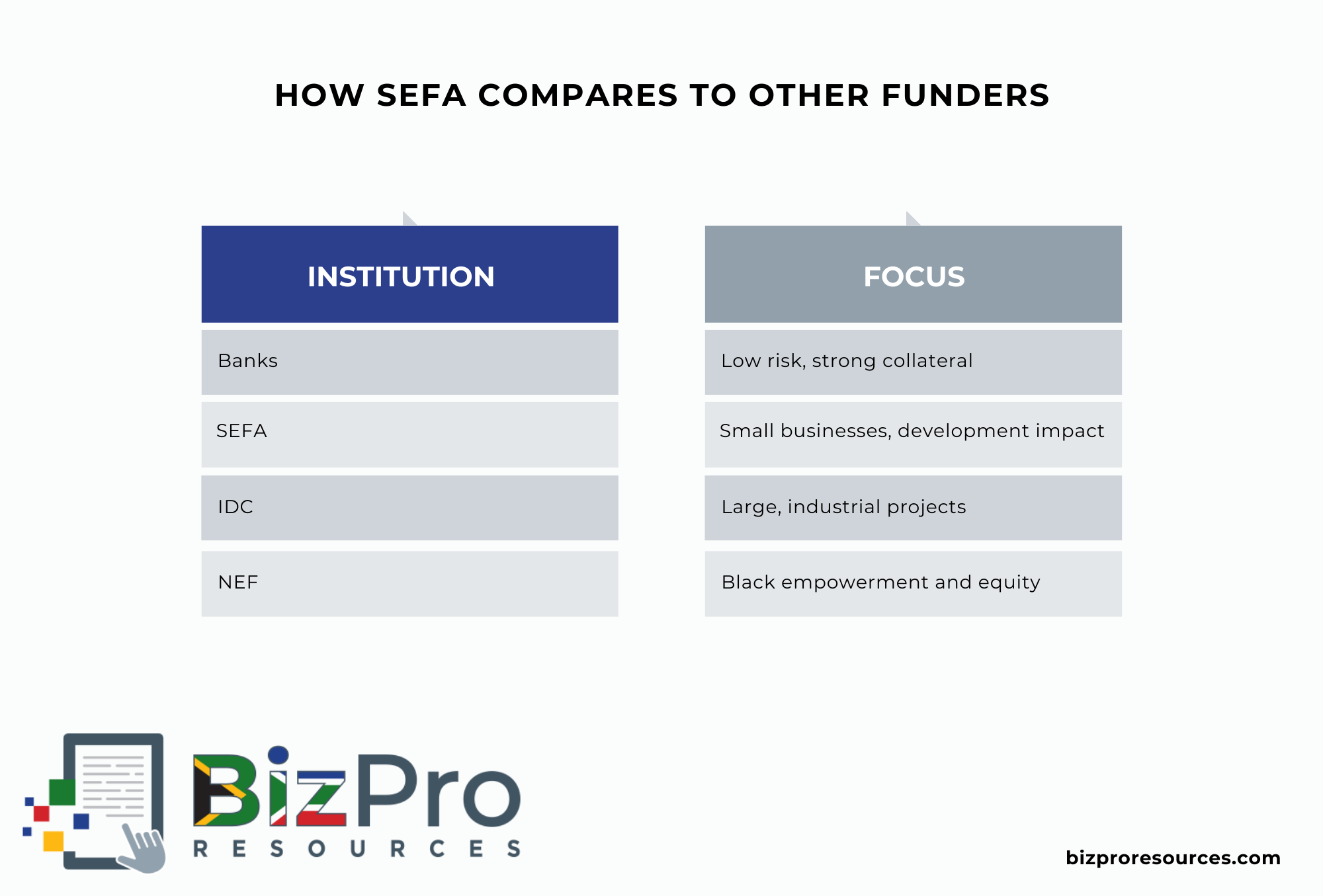
SEFA often acts as a bridge between informal funding and large-scale finance.
Practical Tips Before Applying to SEFA
Before applying:
Formalize your business
Open a dedicated business bank account
Keep basic financial records
Work with SEDA if possible
Be honest about risks and challenges
Preparation dramatically improves approval chances.
Conclusion: Is SEFA the Right Funding Partner for You?
SEFA plays a critical role in South Africa’s small business ecosystem. It is not the easiest funder, but it is one of the most accessible for entrepreneurs who are serious about growing their businesses.
If your business is:
Small but operating
In need of manageable funding
Aligned with development goals
Then SEFA may be an excellent funding partner.
As with all funding decisions, business owners should research thoroughly, prepare carefully, and understand their repayment obligations.
Related Articles in the Business Funding Series
BizPro Resources: An Overview of Funding Options for Small Businesses
BizPro Resources: Understanding Bank Finance for Small Businesses in South Africa
BizPro Resources: Understanding Equity Funding and Venture Capital
BizPro Resources: Growing Your Business with Debt Financing
BizPro Resources: Managing Cash Flow with Alternative Funding
BizPro Resources: Crowdfunding to Fund Your Business Idea
BizPro Resources: Understanding Bootstrapping and Shareholder Loans
BizPro Resources: What Are Government Grants and DFIs?
BizPro Resources: Understanding the Small Enterprise Development Agency (SEDA)
BizPro Resources: Understanding the Industrial Development Corporation (IDC)
BizPro Resources: Understanding the Small Enterprise Finance Agency (SEFA)
BizPro Resources: Understanding the National Empowerment Fund (NEF)
BizPro Resources: Understanding the National Youth Development Agency (NYDA)
BizPro Resources: Understanding the Land Bank Agricultural Funding
BizPro Resources: The Ultimate Step-by-Step Business Funding Decision Guide
AI Disclaimer
AI Tools were used to assist with research. Remember to always cross-check everything that you read.


