
Business Funding: Understanding the Small Enterprise Development Agency (SEDA)
This is article #9 of 15 in the Business Funding Series
Introduction: Why SEDA Exists
Many small businesses fail not because of a lack of funding, but because of poor planning, weak systems, and limited business skills. Even when funding is available, businesses often struggle to manage money, staff, and growth.
The Small Enterprise Development Agency (SEDA) was created to solve this problem. Its role is to build strong, sustainable small businesses by providing non-financial business support.
SEDA does not give loans or grants. Instead, it helps entrepreneurs develop the skills and systems needed to succeed.
What Is SEDA?
SEDA is a government agency that operates under the Department of Small Business Development (DSBD).
Its mandate is to:
Support small, micro, and medium enterprises (SMMEs)
Improve business skills and management capacity
Help businesses become sustainable and competitive
Prepare businesses for funding and growth
SEDA works closely with:
SEFA
NYDA
Provincial development agencies
Private sector partners
What Type of Support Does SEDA Offer?
SEDA provides non-financial support to entrepreneurs at different stages of their business journey.
Core SEDA Support Services
Business Training
SEDA offers training on:
Basic business management
Financial literacy
Marketing and sales
Compliance and governance
Training is usually free or heavily subsidized.
Business Advisory Services
SEDA advisors help with:
Business plans
Cash flow management
Pricing strategies
Operational improvements
3. Business Incubation
SEDA runs incubation programs for:
Startups
Early-stage businesses
High-potential entrepreneurs
These programs often include mentorship and coaching.
4. Market Access Support
SEDA assists businesses with:
Tender readiness
Supplier development
Market linkages
Trade exhibitions (in some cases)
How SEDA Support Works in Practice
SEDA support is needs-based.
This means:
Businesses are assessed first
Support is tailored to specific gaps
Entrepreneurs receive guidance rather than cash
SEDA focuses on capacity building, not rescue funding.
Why Businesses Choose SEDA
Free or Low-Cost Support: SEDA services are accessible to most small businesses.
Practical Business Skills: Support is focused on real-world business challenges.
Preparation for Funding: Many funders prefer businesses that have worked with SEDA.
Long-Term Sustainability: SEDA helps businesses build strong foundations.
Which Businesses Is SEDA Best Suited For?
SEDA is ideal for:
Startups and early-stage businesses
Micro and small enterprises
Informal businesses becoming formal
Entrepreneurs with limited business training
It is less suitable for:
Large corporates
Businesses looking only for funding
Entrepreneurs unwilling to learn
Qualifying Requirements for SEDA Support
Typical Eligibility Criteria
SEDA has very low entry barriers.
Business Size: Micro, small, or medium enterprise
South African Operation: Business must operate in South Africa
Willingness to Participate: Entrepreneurs must attend sessions and follow guidance
Formal registration is helpful but not always required at entry level.
The SEDA Engagement Process
Step 1: Initial Contact
Visit a SEDA branch or apply online
Basic needs assessment
Step 2: Business Diagnosis
SEDA identifies:
Skills gaps
System weaknesses
Growth constraints
Step 3: Support Plan
A support plan is created, which may include:
Training
Advisory sessions
Incubation programs
Step 4: Implementation and Monitoring
Progress is tracked over time.
Advantages of SEDA Support
No Repayment Required: There is no financial obligation.
Skill Development: Entrepreneurs gain practical business knowledge.
Increased Funding Readiness: Improves chances of approval by SEFA, NEF, or banks.
Improved Business Survival: Better systems lead to longer-lasting businesses.
Accessible Nationwide: SEDA has offices across South Africa.
Disadvantages of SEDA Support
No Direct Funding: Businesses still need to source capital elsewhere.
Time Commitment Required: Training and mentoring require attendance and effort.
Varying Quality of Support: Experience may differ by region or advisor.
Not Industry-Specific in All Cases: Some sectors require more specialized support.
South African Success Examples Involving SEDA
Informal Businesses Becoming Formal: Many small businesses have used SEDA support to register, become tax compliant, and open business bank accounts.
Funding-Ready Enterprises: SEDA-supported businesses have gone on to secure funding from SEFA and commercial banks.
Township Entrepreneurs: SEDA has helped township businesses improve operations, pricing, and financial controls.
How SEDA Fits Into the Funding Ecosystem
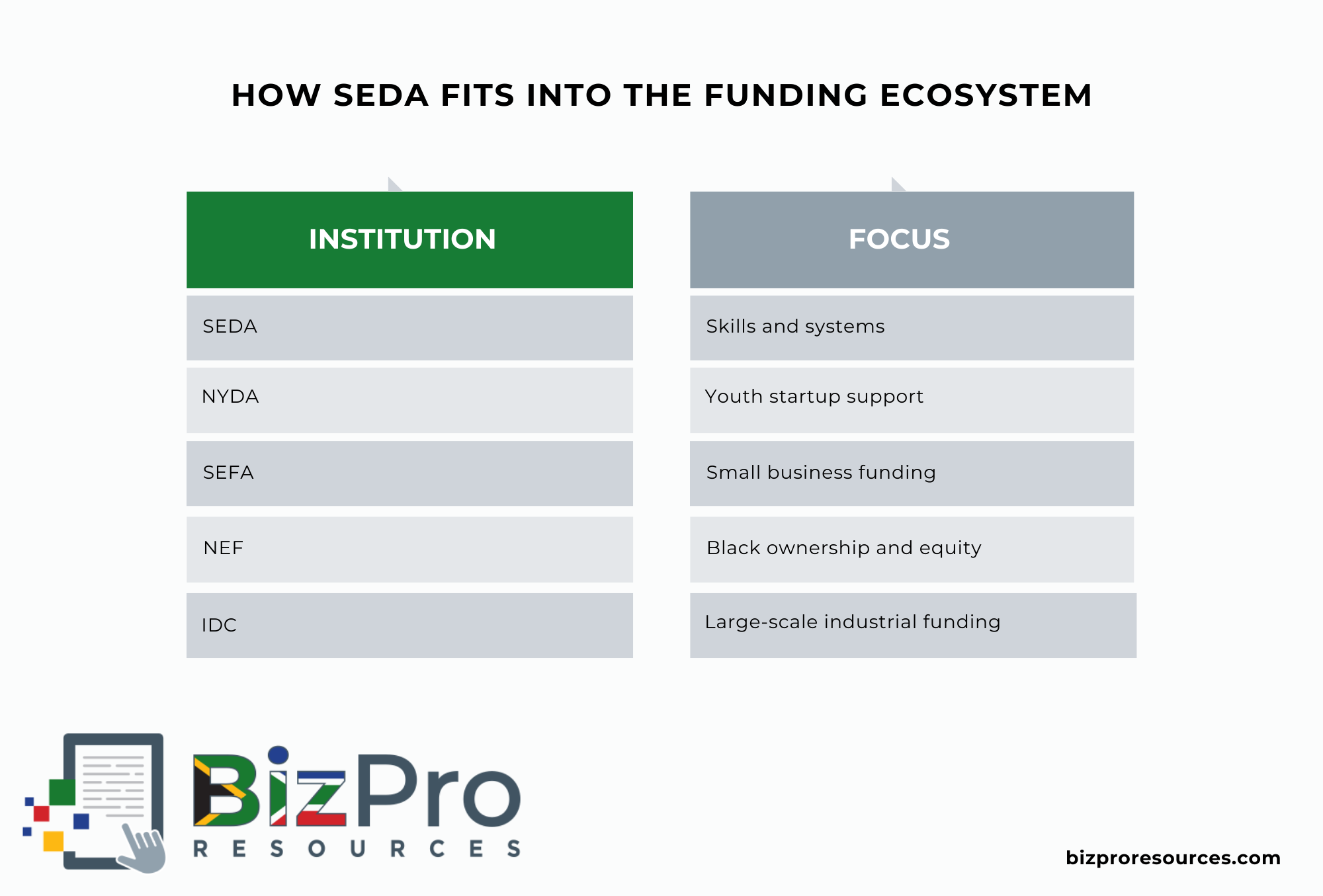
SEDA acts as the foundation layer of the ecosystem.
Practical Advice Before Engaging SEDA
Before engaging with SEDA:
Be open to learning
Be honest about weaknesses
Commit time and effort
Use SEDA before applying for funding
Businesses that engage early benefit the most.
Conclusion: Is SEDA Right for Your Business?
SEDA may not provide money, but it provides something just as important: knowledge and structure.
If your business:
Is small or still growing
Needs better systems
Wants to improve funding readiness
Then SEDA can be a powerful partner in your journey.
Strong businesses are built on skills, not just capital.
Related Articles in the Business Funding Series
BizPro Resources: An Overview of Funding Options for Small Businesses
BizPro Resources: Understanding Bank Finance for Small Businesses in South Africa
BizPro Resources: Understanding Equity Funding and Venture Capital
BizPro Resources: Growing Your Business with Debt Financing
BizPro Resources: Managing Cash Flow with Alternative Funding
BizPro Resources: Crowdfunding to Fund Your Business Idea
BizPro Resources: Understanding Bootstrapping and Shareholder Loans
BizPro Resources: What Are Government Grants and DFIs?
BizPro Resources: Understanding the Small Enterprise Development Agency (SEDA)
BizPro Resources: Understanding the Industrial Development Corporation (IDC)
BizPro Resources: Understanding the Small Enterprise Finance Agency (SEFA)
BizPro Resources: Understanding the National Empowerment Fund (NEF)
BizPro Resources: Understanding the National Youth Development Agency (NYDA)
BizPro Resources: Understanding the Land Bank Agricultural Funding
BizPro Resources: The Ultimate Step-by-Step Business Funding Decision Guide
AI Disclaimer
AI Tools were used to assist with research. Remember to always cross-check everything that you read.


