

Business Funding: Understanding the Land Bank Agricultural Funding
This is article #14 of 15 in the Business Funding Series
Introduction: Why the Land Bank Exists
Agriculture is one of the most important sectors in South Africa. It supports food security, rural employment, exports, and economic stability. However, farming and agri-processing businesses face unique challenges, such as long production cycles, climate risks, and high capital costs.
The Land and Agricultural Development Bank of South Africa (commonly known as the Land Bank) was created to address these challenges by providing specialized funding and financial support to agricultural businesses.
For farmers and agri-entrepreneurs, the Land Bank is often the most appropriate and knowledgeable funding partner.
What Is the Land Bank?
The Land Bank is a state-owned development finance institution (DFI) that operates under the Department of Agriculture, Land Reform and Rural Development.
Its mandate is to:
Support agricultural development
Improve food security
Promote transformation in agriculture
Support rural and farming communities
The Land Bank focuses specifically on primary agriculture and agri-processing, not general business activities.
What Type of Funding Does the Land Bank Offer?
The Land Bank provides debt-based funding, tailored to the realities of agricultural businesses.
Core Land Bank Funding Products
Production Loans
Used to fund:
Seeds, fertiliser, and chemicals
Labour costs
Fuel and operational expenses
These loans are often seasonal and aligned with harvest cycles.
Capital Investment Loans
Used for:
Land purchase
Machinery and equipment
Irrigation systems
Storage facilities
These loans are usually long-term.
Livestock and Equipment Finance
Funding for:
Livestock purchases
Tractors and farming equipment
Farm vehicles
Agri-Processing Finance
Supports businesses involved in:
Food processing
Packaging
Storage and logistics
Value-adding agricultural activities
How Land Bank Funding Works in Practice
Land Bank funding is asset-backed and cash-flow aware.
This means:
Loans are structured around production cycles
Repayments may be seasonal rather than monthly
Risk is assessed based on farming realities
The Land Bank understands that farming income is not consistent throughout the year.
Why Agricultural Businesses Choose the Land Bank
Sector Expertise: The Land Bank understands agriculture better than general banks.
Flexible Repayment Structures: Repayments are aligned to harvest and sales cycles.
Long-Term Funding: Land Bank offers longer loan terms for capital investments.
Development Focus: Transformation and emerging farmers are actively supported.
Which Businesses Is the Land Bank Best Suited For?
The Land Bank is ideal for:
Commercial farmers
Emerging and developing farmers
Agri-processing businesses
Co-operatives in agriculture
Rural agricultural enterprises
It is less suitable for:
Non-agricultural businesses
Informal farming activities with no records
Very small subsistence operations without growth plans
Qualifying Requirements for Land Bank Funding
Typical Eligibility Criteria
Agricultural Activity
Business must operate in agriculture or agri-processing
South African Operation
Farm or operation must be based in South Africa
Commercial Viability
Evidence of production capability
Market access for produce
Security and Assets
Land, equipment, or other assets may be required as security
Compliance
Environmental compliance
Water use rights (where applicable)
Proper business registration and tax compliance
The Land Bank Application Process
Step 1: Initial Engagement
Visit a Land Bank office or apply online
Preliminary assessment
Step 2: Documentation Submission
Applicants submit:
Business or farm plan
Production budgets
Financial statements or projections
Asset and land details
Step 3: Risk and Technical Assessment
Land Bank assesses:
Agricultural risk
Market conditions
Climate and environmental factors
Step 4: Approval and Contracting
Loan terms are finalized and agreements signed.
Step 5: Disbursement and Monitoring
Funds are released, and performance is monitored over time.
Advantages of Land Bank Funding
Agriculture-Specific Products: Funding is designed for farming realities.
Long-Term Capital: Supports sustainable agricultural growth.
Seasonal Repayment Options: Reduces cash-flow pressure.
Support for Emerging Farmers: Transformation programs are available.
Rural Economic Development: Supports rural communities and employment.
Disadvantages of Land Bank Funding
Exposure to Agricultural Risk: Weather and climate events increase risk.
Security Requirements: Assets or land may be required as collateral.
Detailed Assessments: Applications require technical and financial detail.
Processing Time: Approval can take several months.
Limited Scope: Only suitable for agriculture-related businesses.
South African Success Examples Involving the Land Bank
Commercial Crop Farmers: Many crop farmers have expanded production capacity using Land Bank production and capital loans.
Emerging Black Farmers: Land Bank programs have supported emerging farmers in acquiring land, equipment, and livestock.
Agri-Processing Businesses: Food processors have used Land Bank funding to build facilities and add value to raw agricultural products.
How the Land Bank Fits Into the Funding Ecosystem
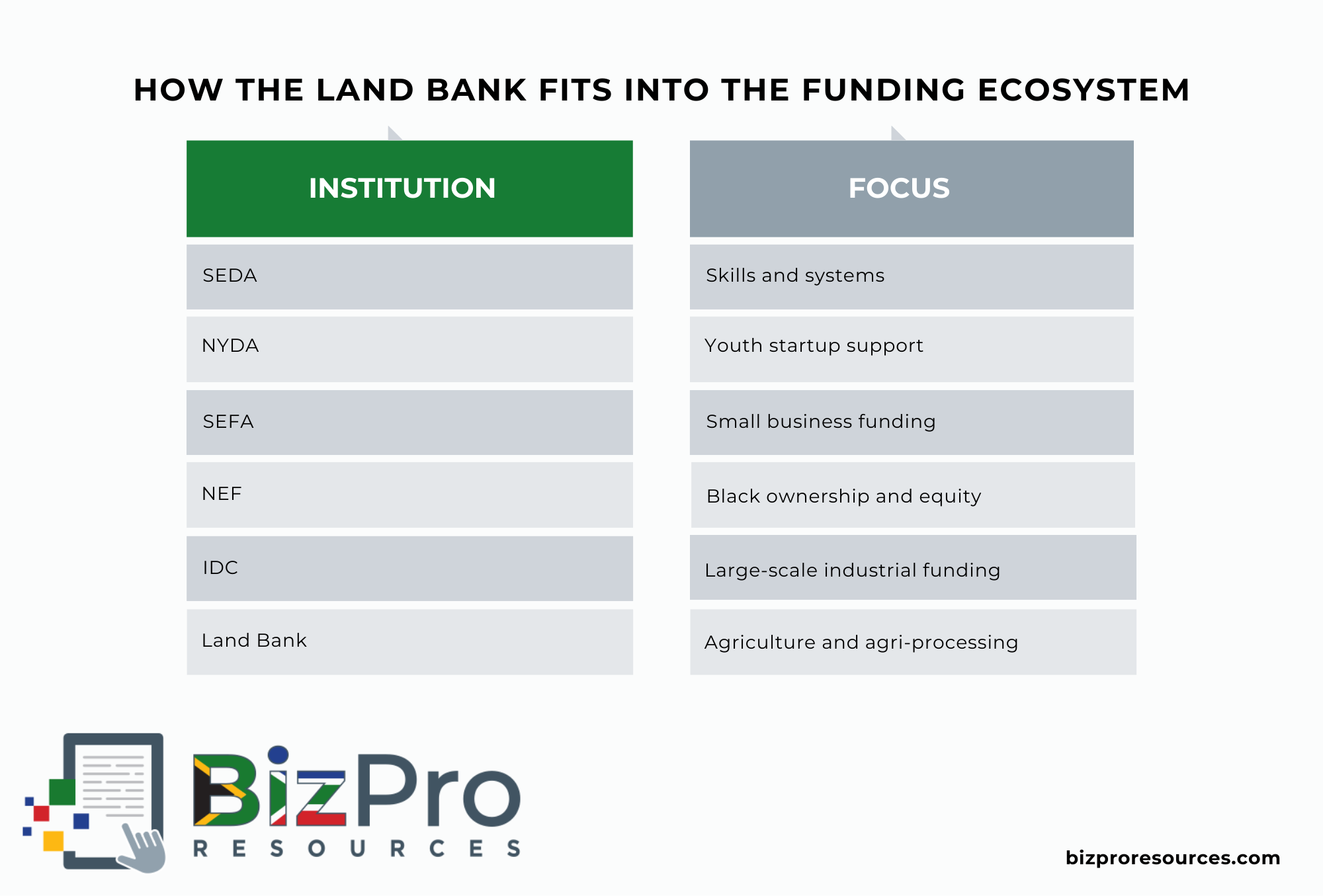
The Land Bank fills a critical sector-specific role that general funders cannot.
Practical Advice Before Applying to the Land Bank
Before applying:
Keep accurate production records
Understand your costs and yields
Plan for climate and market risks
Ensure compliance with regulations
Prepare for a detailed assessment
Strong preparation greatly improves approval chances.
Conclusion: Is the Land Bank Right for Your Business?
The Land Bank is a vital institution for South Africa’s agricultural economy. It offers specialized, long-term funding that aligns with the realities of farming and agri-processing.
If your business is:
Agriculture-focused
Commercially viable
Growth-oriented
Willing to meet compliance requirements
Then the Land Bank can be an excellent funding partner.
Choosing the right funding institution is not about speed — it is about fit, sustainability, and long-term success.
Related Articles in the Business Funding Series
BizPro Resources: An Overview of Funding Options for Small Businesses
BizPro Resources: Understanding Bank Finance for Small Businesses in South Africa
BizPro Resources: Understanding Equity Funding and Venture Capital
BizPro Resources: Growing Your Business with Debt Financing
BizPro Resources: Managing Cash Flow with Alternative Funding
BizPro Resources: Crowdfunding to Fund Your Business Idea
BizPro Resources: Understanding Bootstrapping and Shareholder Loans
BizPro Resources: What Are Government Grants and DFIs?
BizPro Resources: Understanding the Small Enterprise Development Agency (SEDA)
BizPro Resources: Understanding the Industrial Development Corporation (IDC)
BizPro Resources: Understanding the Small Enterprise Finance Agency (SEFA)
BizPro Resources: Understanding the National Empowerment Fund (NEF)
BizPro Resources: Understanding the National Youth Development Agency (NYDA)
BizPro Resources: Understanding the Land Bank Agricultural Funding
BizPro Resources: The Ultimate Step-by-Step Business Funding Decision Guide
AI Disclaimer
AI Tools were used to assist with research. Remember to always cross-check everything that you read.


