Business Funding: Understanding the Industrial Development Corporation (IDC)
This is article #10 of 15 in the Business Funding Series
Introduction: What Is the IDC and Why It Matters
The Industrial Development Corporation (IDC) is one of South Africa’s most important development finance institutions. Its main purpose is to support industrial development, job creation, and economic growth by funding businesses that align with national development goals.
Unlike banks, the IDC is not only focused on profit. It exists to develop the economy, especially in areas where private funding may be limited or too expensive. Because of this, the IDC can offer funding structures that are more flexible than traditional bank finance — but the requirements are still strict.
This article explains what the IDC is, how it works, who it funds, what it looks for, and how business owners can realistically approach an IDC funding application.
What Is the IDC?
The IDC is a state-owned development finance institution (DFI) established in 1940. It operates under the Department of Trade, Industry and Competition (DTIC).
Its mandate is to:
Promote industrial development
Support strategic sectors
Encourage job creation
Support transformation and inclusive growth
The IDC does not fund survival businesses. It funds commercially viable businesses that can scale and contribute meaningfully to the economy.
How the IDC Provides Funding
Types of Funding Offered by the IDC
The IDC provides funding through several instruments:
Debt Financing (Loans): These are medium- to long-term loans used for:
Equipment and machinery
Factory setup or expansion
Working capital (in some cases)
Interest rates are usually competitive and linked to risk and development impact.
Equity Funding: The IDC can take a shareholding in a business, especially in:
Large projects
High-growth industries
Strategic sectors
This means the IDC becomes a partner, not just a lender.
Quasi-Equity / Hybrid Structures: These are flexible structures that combine features of debt and equity, such as:
Preference shares
Convertible instruments
How IDC Funding Differs from Bank Funding
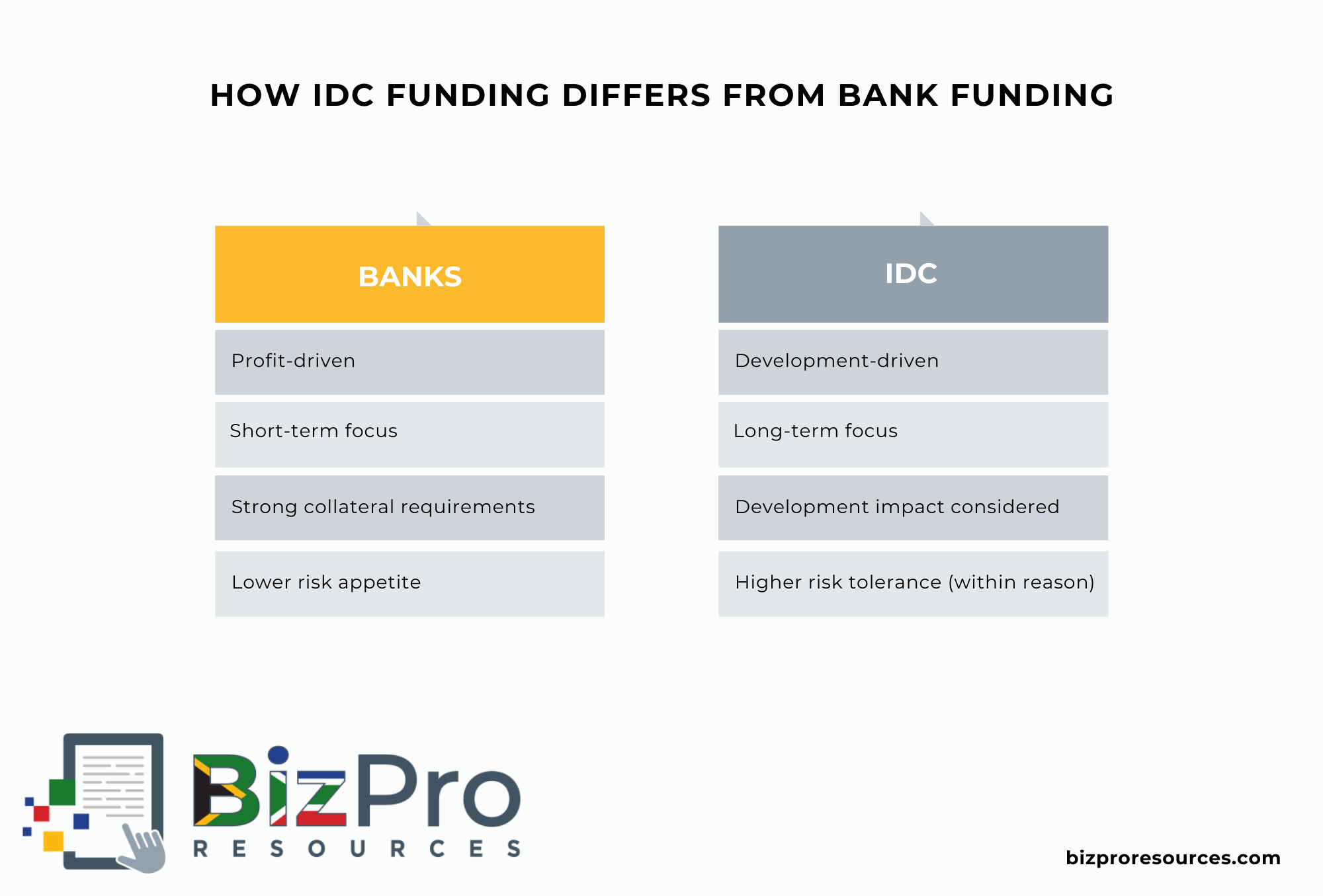
That said, the IDC is not soft funding. Poorly prepared applications are quickly rejected.
Key Sectors Funded by the IDC
The IDC focuses on priority industries that align with national development strategies.
Common sectors include:
Manufacturing
Agro-processing
Mining and mineral beneficiation
Renewable energy
Chemicals
Automotive and components
Industrial services
Technology and innovation (selectively)
Retail, hospitality, and small service businesses are generally not funded, unless they are part of a larger industrial value chain.
Why Businesses Choose the IDC
Access to Large-Scale Funding: The IDC can fund projects that are too large or too risky for commercial banks.
Long-Term Perspective: Repayment terms are often longer, allowing businesses time to grow.
Flexible Structures: The IDC can tailor funding to the project rather than forcing a standard loan product.
Strategic Partnership: The IDC often provides strategic oversight, governance support, and industry expertise.
Which Businesses Is the IDC Best Suited For?
The IDC is best suited for:
Established businesses looking to expand
Capital-intensive projects
Manufacturing and industrial operations
Businesses aligned with industrial policy
Projects that create sustainable jobs
It is not suitable for:
Micro businesses
Informal businesses
Early-stage startups with no traction
Businesses without proper financial records
Qualifying Requirements for IDC Funding
Core Eligibility Requirements
While each application is assessed individually, most IDC-funded businesses must meet the following:
South African Registration:
Business must be registered in South Africa
Compliant with SARS and CIPC
Commercial Viability:
Clear revenue model
Realistic financial projections
Evidence of demand
Development Impact - Projects are assessed on:
Job creation
Skills development
Transformation (B-BBEE)
Local procurement
Industrialization impact
Management Capability:
Experienced management team
Proven operational ability
Strong governance structures
Own Contribution:
The IDC almost always requires the business owner to contribute equity or capital to the project.
The IDC Application and Approval Process
Step 1: Initial Engagement
Online enquiry or sector desk engagement
Preliminary screening
Step 2: Formal Application
Business plan
Financial statements
Financial models
Market analysis
Environmental and regulatory compliance
Step 3: Due Diligence
The IDC conducts:
Financial due diligence
Technical assessments
Legal checks
Environmental impact assessments (if required)
Step 4: Investment Committee Approval
Projects are reviewed internally and approved at different levels depending on size and risk.
Step 5: Legal Agreements and Disbursement
Once approved, funding is released according to agreed milestones.
Advantages of IDC Funding
Large Funding Capacity: The IDC can fund projects worth hundreds of millions of rand.
Development-Focused Terms: Terms often reflect long-term development goals rather than short-term profit.
Sector Expertise: Access to deep industry knowledge.
Credibility Boost: IDC involvement increases credibility with suppliers and other funders.
Patient Capital: The IDC understands long project lead times.
Disadvantages of IDC Funding
Complex Application Process: Applications are detailed and time-consuming.
Long Approval Timelines: Approval can take several months.
High Reporting Requirements: Ongoing compliance and reporting is required.
Limited Sector Scope: Many businesses simply do not qualify.
Reduced Control (Equity Deals): Equity funding may dilute ownership and decision-making power.
International Comparisons
Internationally, similar institutions include:
Germany’s KfW
China Development Bank
Brazil’s BNDES
Like the IDC, these institutions:
Fund strategic industries
Focus on national development
Offer long-term capital
The IDC operates on similar principles, adapted to South Africa’s economic priorities.
South African Success Stories Involving the IDC
Sasol (Early Development): The IDC played a critical role in funding Sasol during its early development stages, supporting synthetic fuel production and industrial growth.
Renewable Energy Projects: The IDC has funded multiple renewable energy plants under South Africa’s energy programs, contributing to energy security and job creation.
Manufacturing Expansion Projects: Numerous mid-sized manufacturers have expanded capacity with IDC funding, enabling export growth and localization.
Practical Advice Before Applying to the IDC
Before applying, business owners should:
Ensure financial records are clean and up to date
Align the project with national development goals
Prepare realistic projections
Secure professional assistance if needed
Be prepared for a long process
IDC funding is not transactional — it is strategic.
Conclusion: Is the IDC Right for Your Business?
The Industrial Development Corporation is one of the most powerful funding partners available to South African businesses, but it is not suitable for everyone.
If your business is:
Industrial or manufacturing-focused
Commercially viable
Growth-oriented
Aligned with development priorities
Then the IDC can provide long-term, strategic funding that few other institutions can match.
However, success with the IDC requires preparation, patience, and professionalism. Businesses that approach the IDC with a clear strategy and strong fundamentals stand the best chance of approval.
Related Articles in the Business Funding Series
BizPro Resources: An Overview of Funding Options for Small Businesses
BizPro Resources: Understanding Bank Finance for Small Businesses in South Africa
BizPro Resources: Understanding Equity Funding and Venture Capital
BizPro Resources: Growing Your Business with Debt Financing
BizPro Resources: Managing Cash Flow with Alternative Funding
BizPro Resources: Crowdfunding to Fund Your Business Idea
BizPro Resources: Understanding Bootstrapping and Shareholder Loans
BizPro Resources: What Are Government Grants and DFIs?
BizPro Resources: Understanding the Small Enterprise Development Agency (SEDA)
BizPro Resources: Understanding the Industrial Development Corporation (IDC)
BizPro Resources: Understanding the Small Enterprise Finance Agency (SEFA)
BizPro Resources: Understanding the National Empowerment Fund (NEF)
BizPro Resources: Understanding the National Youth Development Agency (NYDA)
BizPro Resources: Understanding the Land Bank Agricultural Funding
BizPro Resources: The Ultimate Step-by-Step Business Funding Decision Guide
AI Disclaimer
AI Tools were used to assist with research. Remember to always cross-check everything that you read.


